DBT Distress Tolerance Skills

What is DBT?

Dialectical Behavior Therapy’s (DBT) premise is that two seemingly opposite things can be true at the same time. For example, my parents did the best they knew how when raising me and they negatively affected my emotional development.  

DBT trains the mind to think with a good balance between reason and emotion, calling this the “wise mind.” It also can keep you out of all or nothing or black and white thinking. There are many shades of grey with everything in life. 

There are four main tenets of DBT. They are Distress Tolerance, Mindfulness, Emotional Regulation, and Interpersonal Skills. 

Distress Tolerance and Radical Acceptance

Distress Tolerance includes an idea called “Radical Acceptance” where you fully acknowledge the present moment reality. This does not equal condonement. Radical acceptance places you in a position of being able to make a plan to elicit changes in your life because you cannot change anything if you aren’t fully engaged in the acceptance of what currently is. 

Distress Tolerance skills include distraction and self-soothing. Distract by engaging in pleasurable, non-destructive activities, focusing on helping others, doing chores, counting breaths or anything you can see, or distract by removing yourself from the situation.

Self-soothe any of your senses: smell, sight, sound, taste and touch. Use any input that makes you feel good that is non-destructive and not harmful to you or anyone else. 

R.E.S.T.

Above all, make sure to use the “Rest” technique in any situation that is upsetting to you at the start. Relax (R), Evaluate the facts (E), Set an intention (S), Take action (T).  The intention and take action steps could include some ideas from the distress tolerance skills.

More to come on DBT skills…

Differences Between Depression and Sadness

Everyone feels sad at some point in their life but not everyone gets depressed. Usually sadness is a result of some specific external event or reason going on in someone’s life from something as serious as the death of a loved one to something less serious like failing an important exam. This is not to say that some things that cause sadness such as these cannot lead into depression if it goes on for a long period of time.

Main Differences Between Sadness and Depression

  • A person with sadness can usually find some relief from crying, venting, or talking out frustrations. Those with depression can do the same thing but often don’t find the same kind of relief. They continue to feel very sad with the added symptoms of hopelessness, lack of motivation, and loss of interest in activities that they once found enjoyable.
  • Sadness usually passes with time. Depression tends to last weeks or months and may lead to those with it thinking about or attempting suicide. They may also no longer feel like spending time with family or friends and might become disinterested in their usual hobbies and feel unable to attend work or school.
  • Sadness is just one part of depression. Other symptoms of depression that aren’t necessarily seen in sadness include a daily depressed mood that lasts for most of the day, nearly every day, with signs of hopelessness and sadness. There’s also a loss of interest in normal activities for an extended amount of time, significant and unintentional weight loss or gain, insomnia, sleepiness, or increased amounts of sleep that affect normal schedules, tiredness and low energy, feelings of worthlessness or excessive guilt on a daily basis, inability to concentrate or make decisions, and recurrent thoughts of death, suicidal thoughts, or suicidal attempts or plans. A person who experiences any five of these symptoms for longer than two weeks would probably be diagnosed as having depression rather than a prolonged experience of sadness.

If you feel like you are experiencing depression rather than sadness, contact your medical professional as soon as possible. There are many treatment options available for people with depression including medications and psychotherapy and counseling.

Comorbidities in People with Mental Illness

Comorbidities in people with mental illness means they have another disorder in addition to their mental illness. This is quite common. I, for example, have bipolar disorder and chronic migraine.

Comorbidities do not have to be a mental disorder paired with a physical disorder. They can also be two or more mental disorders or two or more physical disorders.

Having more than one disorder has its challenges. For example, a person with both multiple sclerosis and depression would be treated for both conditions, but it would be important to take into consideration the overlap between medications that would be prescribed by different doctors.

For this reason, people with comorbid disorders should take good notes of their symptoms, medications and their side effects, and anything they and their doctors discuss at each appointment so that unwanted interactions are avoided. It is also important to have excellent communication with all providers so that everyone knows what everyone else is doing.

If you have comorbidities, you must be a persistent advocate for yourself to get the proper treatment plan in place to treat all of your disorders so that you can reach and maintain optimal health, both physically and mentally. By following the aforementioned suggestions you can be on your way to better health no matter how many comorbidities you have.

Depression Basics and Where to Get Help

Depression is a clinical disorder that is very treatable. It is more than feeling sad for a short period of time and can increase feelings of helplessness, hopelessness, and worthlessness for days, weeks or months at a time. Clinical depression also keeps you from living your life the way that you used to before you became depressed. There’s no cure for depression, but your symptoms may go away over time and you may become stable again with treatment and medical care.

Depression Symptoms

Depression symptoms include:

  • Your mood is depressed for most of the day, especially in the morning.
  • You feel tired or have a lack of energy almost every day.
  • You feel worthless or guilty most every day.
  • You feel hopeless or pessimistic.
  • You have a hard time focusing, remembering details, and making decisions.
  • You can’t sleep, or you sleep too much, almost every day.
  • You have almost no interest or pleasure in many activities nearly every day.
  • You think often about death or suicide.
  • You feel restless or slowed down.
  • You’ve lost or gained weight.

You may also:

  • feel cranky and restless
  • lose pleasure in life
  • over eat or stop feeling hungry
  • have aches, pains, headaches, cramps, or digestive problems that don’t go away or get better with treatment
  • have sad, anxious, or empty feelings. (WedMD)

Not everyone experiences all of these symptoms and some people may experience other ones not listed.

Depression and Suicide

You should take anyone who thinks or talks about hurting themselves very seriously. In the US call 800-SUICIDE (800-784-2433); 800-273-TALK (800-273-8255); for hearing impaired, call 800-799-4889. Or you can contact a mental health professional. If you intend to or have a plan to attempt suicide, go to the emergency room immediately.

Do you identify with any of the symptoms of depression? If so, please talk with your doctor or mental health professional about them right away.

Should You Take Medication to Treat Your Mental Illness?

To take medication for a mental illness is a very personal choice. For me, medication has allowed me to live a life with some stability in my moods and has helped me to be a better wife, mom, and friend. 

I have severe symptoms that do not subside without medication because I believe my brain is imbalanced with regards to certain neurotransmitters, such as Serotonin, Dopamine, and Norepinephrine.  There are side effects, such as drowsiness and weight gain, but these need to be weighed against the benefits to decide if the medicine is worth taking or not. 

Some people can manage their symptoms with non-medication interventions such as counseling, lifestyle changes, diet, prayer and meditation, exercise, and journaling/keeping mood charts to stay on top of their mental health status.

It is up to the individual whether or not to treat their mental illness with medication and it is none of everyone else’s business to criticize what they decide to do. 

Any thoughts? Join the conversation and leave a comment.

Being a Mom with Anxiety

I became a mom almost 21 years ago. I was not yet diagnosed with mental illness. About six months into motherhood when postpartum depression had a strong hold on me, I went to my doctor for help and she put me on an antidepressant. About six years later, after the birth of my second child, I was diagnosed with bipolar type 2 disorder. It is at this point that I think my anxiety developed into something that I could not handle without professional help or medication because I began to have panic attacks along with generalized anxiety and eventually severe social anxiety.

Play dates were difficult at best and attending sporting events were and still are extremely stressful and anxiety producing (hint: wearing earbuds playing calming music helps a lot!) Having children who are growing up with their own anxiety and depression issues only increases the stress of motherhood exponentially for a mom with anxiety. On the up side, having an anxiety disorder has better equipped me to completely empathize with my children and help them in ways I would not be able to if I hadn’t already learned skills to deal with my own anxiety.  Some of these skills include the following:

  • Setting healthy boundaries by saying no to things when I feel I am reaching my threshold for responsibilities and daily activities. 
  • Asking for help with daily responsibilities from my partner, family, and friends.
  • Taking time for self care activities like reading a chapter of a book, journaling, taking a bubble bath, listening to calming music, watching an episode of a series I enjoy, petting my dog or cat, taking a nap, sitting in the sun for a few minutes, doing my nails, getting my hair done, meditating, or doing some stretches or simple yoga exercises.
  • Not being hard on myself when I can’t do things I wish I could. 
  • Accepting my limitations.
  • Praying for the strength to do as much as possible without making myself sick.
  • Being thankful for all I can do and for all I have instead of focusing on the negative aspects of having an anxiety disorder. 

Being a mom with anxiety has its challenges, but with an awareness of and honoring what your limitations are and following the suggestions above, you can thrive as a mom and a person with anxiety. 

Why I Took a Mental Health Hiatus

It has been nine months since I posted here because I needed to take a break from thinking and talking and writing about mental health and mental illness.

I went through a big change around the time I quit blogging and I suppose that has something to do with the long break as well. This change altered some of my core values and helped me grow as a person in ways I never would have imagined. My love and tolerance for all people has blossomed exponentially.

I dare say I went about a psychic change that brought me through a depression and grieving process to a place of total acceptance. I am a better person for it today.

However, even with the positive impact this event had on my character, I still have all of my mental illnesses (bipolar type 2, anxiety and panic disorders, social anxiety disorder, ADHD, seasonal affective disorder, complex PTSD, recovered alcoholism, borderline personality traits).

The most prevalent illness currently causing problems for me is anxiety. The social and generalized anxieties are the main triggers for my chronic migraine. The ways in which I limit my activities outside of the house in order to decrease my migraine frequency has made my world very small.

Is your life limited because of your symptoms? How so? Tell me in the comments and follow me for more mental health updates.

Mental Health Awareness Month 2021

We are half way through Mental Health Awareness Month.  Awareness for mental health is so important because people die everyday from poor mental health. People can’t work due to poor mental health or take care of their family or get out of bed. We have to bring awareness to this in order to normalize it in such a way that those who find themselves in such situations don’t hesitate to get professional help.

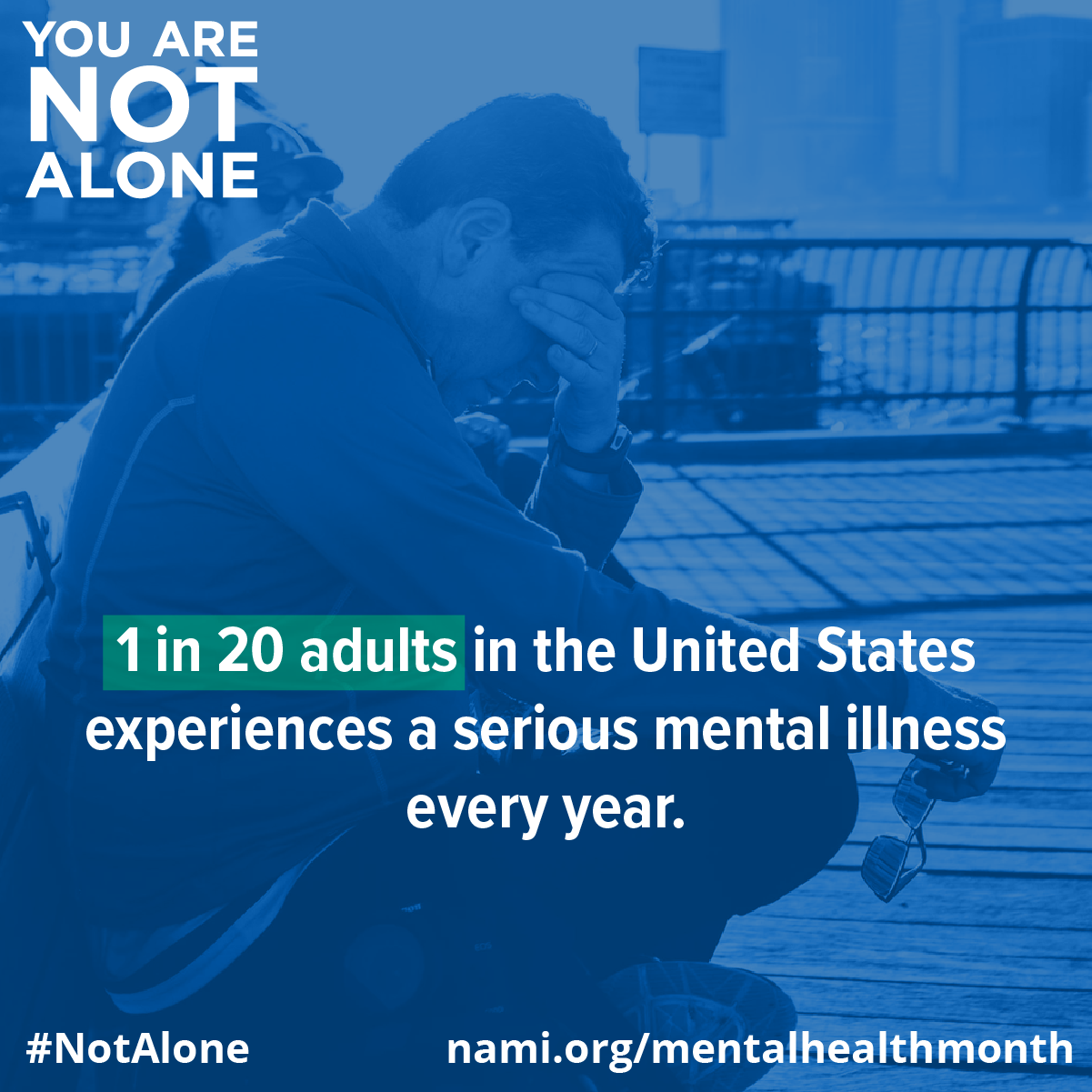
Twenty percent of adults in the United States experience a mental health condition in a given year. This topic deserves our attention and consideration. People are suffering and need help. 

What are some ways we can raise awareness?

– Download You Are Not alone graphics, logos and social media images from NAMI (National Alliance on Mental Illness) at https://www.nami.org/Get-Involved/Awareness-Events/Awareness-Resources

– Share the following mental health facts taken from nami.org with permission.

– Host a Facebook or Instagram Live with an expert or a person with real life experience to discuss how people can manage their mental health or practice self-care.

– Share a video of what mental health means to you. Use video sharing apps like TikTok or Instagram reels to create videos to post on your social media profiles.

– Use the following social media hashtags for Mental Health Awareness Month:

#NotAlone
#MentalHealthMonth
#MHM

– Promote NAMI Helpline’s contact information and hours of availability as a resource for people seeking mental health support. Monday – Friday 8:00 a.m. to 8:00 p.m. ET. 800-950-NAMI (6264). info@nami.org nami.org/Help

How are you going to help increase mental health awareness this month?

Feel free to use these graphics from NAMI.

World Maternal Mental Health Day 2021

Today is World Maternal Mental Health Day, which purpose is to draw attention to the mental health concerns for mothers and families. The changes that pregnancy and having children brings in life makes women more vulnerable to mental illness.

I was first diagnosed with depression not long after my first child’s birth.  I was later diagnosed with type 2 bipolar disorder after the birth of my second child.

Worldwide, as many as 1 in 5 women experience some type of perinatal mood and anxiety disorder. These disorders include postpartum depression, postpartum anxiety, postpartum obsessive compulsive disorder, postpartum bipolar, and postpartum psychosis.  Symptoms can appear at any time during pregnancy and the first 12 months after childbirth.

Health professionals and friends and relatives of new moms need to ask the mom how she really is feeling and encourage her to seek help if she is struggling.

To learn more about this movement visit https://wmmhday.postpartum.net/

Let’s Talk About Stress

Today is National Stress Awareness Day.

Stress is physical, emotional, or psychological tension felt as a result of an event or thought that causes feelings of frustration, anger, or anxiety.  In short bursts, stress can be helpful, like in getting you out of a dangerous situation or helping you meet a deadline. When chronic, however, it can be harmful to your health and contribute to the development of conditions such as 

  • High blood pressure
  • Heart disease
  • Diabetes
  • Obesity
  • Depression or anxiety
  • Skin problems, such as acne or eczema
  • Menstrual problems

Common causes of stress include

  • Getting married or divorced
  • Starting a new job
  • The death of a spouse or close family member
  • Getting laid off
  • Retiring
  • Having a baby
  • Money problems
  • Moving
  • Having a serious illness
  • Problems at work
  • Problems at home

Signs of chronic stress include

  • Diarrhea or constipation
  • Forgetfulness
  • Frequent aches and pains
  • Headaches
  • Lack of energy or focus
  • Sexual problems
  • Stiff jaw or neck
  • Tiredness
  • Trouble sleeping or sleeping too much
  • Upset stomach
  • Use of alcohol or drugs to relax
  • Weight loss or gain

Sometimes stress can be managed by getting the right amount of sleep, talking problems over with a trusted friend, getting regular exercise and proper nutrition, and generally taking good care of yourself. Other times if you find yourself having panic attacks, feeling overwhelmed for weeks on end, or unable to function at work or home, you should probably contact your doctor or mental health professional for some help. 

Source: https://medlineplus.gov/ency/article/003211.htm

How do you cope with stress in your life?