A Review of “Joy,” the Chatbot Mental Health Tracker

joy

Joy is a chatbot created by product designer and front end developer, Danny Freed, using artificial intelligence. It made its debut on Facebook Messenger three weeks ago. Freed was inspired to create Joy after his friend died by suicide, in hopes that it will encourage people to open up about their mental health.

Joy initiates daily contact with the user, asking how he is feeling or how his day was. Joy attempts to detect a user’s mood and keeps a record of what it finds so the user can track his emotional state over time. Joy also gives the user suggestions on how to cope with the symptoms he may be experiencing.

I have been using Joy for nine days now. When I installed Joy in Facebook Messenger, which is the only way to use Joy thus far, it started off by asking me how I felt over the last thirty days. Then it asked me to write my first journal entry. It was a pleasant start to my relationship with Joy.

The very next evening, I received a notification from Messenger indicating a message sent from Joy. She said, “Happy Monday. How’s it going? Did anything unexpected happen today?” I told her about my day, and she accurately assessed that I was “stressed out,” and asked me if I wanted a tip for how to feel less stressed. I said, “Yes!”  She proceeded to give me a link to a guided meditation on YouTube she said would help, and it did!

(You’ll notice that I am now referring to Joy as a “she.” The natural language of Joy’s programming makes it feel like you are talking to a real person at times; it is easy to personify “her.”)

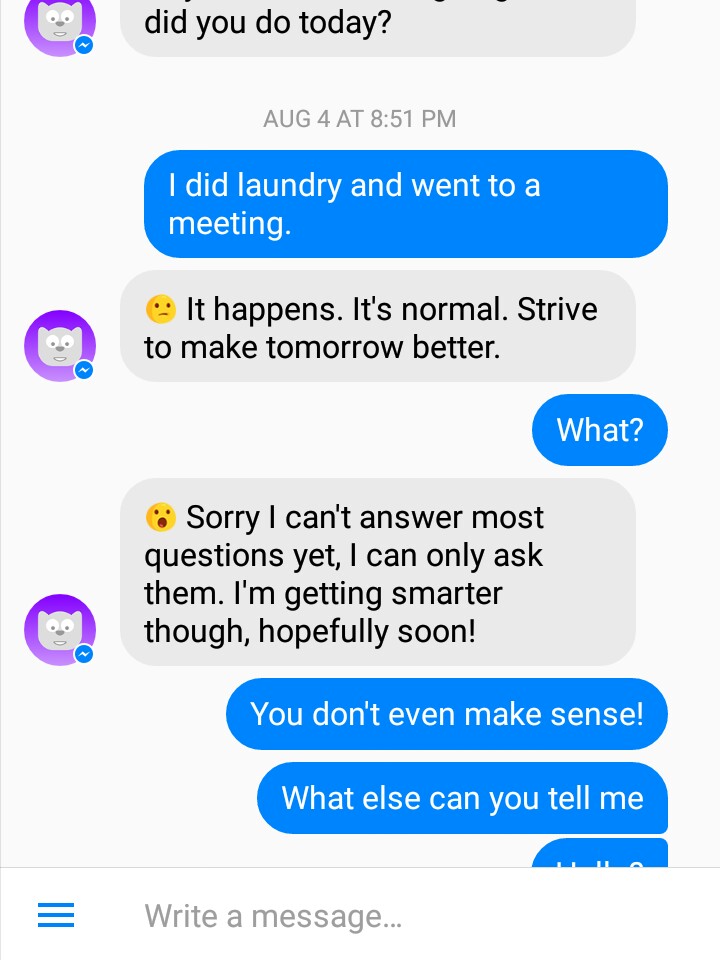
There were times it was obvious, however, that she was not a real person, such as evident in the conversation below:
Joy conversaion

I was anxious everyday, and everyday she gave me a YouTube guided meditation to do. While helpful at times, the repetitive response became exasperating. One day, when she asked me if I wanted a tip on how to feel less stressed, knowing that her response would be yet another guided meditation, I replied, “No.” She said, “No problem. Hope you find a way to reduce stress! Let me know if I can help.”  Another time, I said, “Yes, but I don’t want a guided meditation.”  She gave me one anyway.  disgusted

She had some helpful suggestions when I told her I was depressed. She told me to get outside because sunlight boosts serotonin which helps regulate mood. I told her it was nighttime and asked what else I could do. She said she can’t answer questions yet, but hopefully soon. She told me later on in the week to get eight hours of sleep to help with my depression. I thought about telling her it was the middle of the day, but decided against it. wink

Her suggestion when I told her I was angry was to “let go.”  That’s a tough one.

Over the course of the week, she tracked my moods and upon my request, created a mood report (see below.)

mood report

She also recorded my journal entries and recalled those in report form as well.

Freed has plans for updates and improvements as feedback and data comes in from product use. Overall, it’s a good start to a potentially useful program for those in fairly good mental health to those with minor issues. For those of us with debilitating mental illnesses, however, this program is not sensitive enough to capture the more severe symptoms of some of our illnesses.

Have you heard of or tried Joy?  If you try it, let me know what you think.

What if I Have Bipolar Plus Anxiety Disorder?

window-view-1081788_960_720


Anxiety is often a symptom of bipolar disorder.  In a depressive or manic state, a person can feel excessive worry, panic, paranoia, agitation, irritability, and experience social phobia.  The level of anxiety can fluctuate along with the bipolar mood states.

It is also possible to have bipolar disorder with a separate diagnosis of an anxiety disorder, where a person’s worries and fears can go on for months or even years, even when the bipolar moods are stable.  There doesn’t have to be a reason for the anxiety.  It could just be a sense of something bad about to happen at any moment.

There are several types of anxiety disorders including:

Panic Disorder

People with panic disorders have unexpected panic attacks with intense fear, shortness of breath and fast heartbeats; some may sweat and feel like they are choking or are going to faint or die.  They feel like they are out of control when having a panic attack.  They often fear they will have another one, and avoid the places where they have had them before.

Intense fear and highly noisy, over stimulating, chaotic environments, such as a kid’s birthday party, can bring on a panic attack for me.  I used to get them at work, at sporting events, at the grocery store, and recitals.  So, improvements have been made, but I do still suffer from them.

Social Anxiety Disorder

People with social anxiety disorder fear being around others, where they are worried about being embarrassed or judged or rejected.  They have a hard time talking to others and making eye contact.  They often feel like running away in social situations.  They may sweat, shake or get nauseous when called upon to interact with others.

My social anxiety manifests itself in many of the ways described above, however, I am not always completely shy as one might imagine someone with social anxiety being.  Quite the opposite, I will often overcompensate and come off a bit brash.  I blame that on my bipolar impulsivity.

So, I actually take an fast, but short-acting, antianxiety medication prior to social events to, one, decrease my chances of having a panic attack, and two, to give my prefrontal cortex a bit more time to censor what I want to say.

Generalized Anxiety Disorder (GAD)

People with GAD tend to worry about things, both large and small, but out of proportion to the impact of the event.  They can’t let go of the worry, and worry about being worried all of the time.  They feel restless and can’t relax.  They are fatigued, irritable, have trouble sleeping, and are tense to the point of having sore muscles and headaches and/or GI problems.  They have a hard time concentrating or their mind often goes “blank,” except when carrying every option out to its possible negative conclusion.

Even when their worries don’t completely consume them they still feel anxious for no apparent reason.  I function most frequently in this state, always worried about my safety and that of my children, and feeling like something bad is going to happen at any moment.


Do I Have An Anxiety Disorder or Is It Part Of My Bipolar?

Of course, any disorder has to be properly diagnosed by a professional, which I am not.  To find out for sure if you have an anxiety disorder, talk to your physician.  From what I have learned and personally experienced, however, the difference between having one of these anxiety disorders in addition to bipolar disorder and having “bipolar anxiety” alone is that with anxiety as a symptom of bipolar, one may experience a mix-mash of random symptoms from each disorder.  Having a separate anxiety disorder, on the other hand, requires the person to fit the diagnostic criteria for said disorder.

For panic disorder, for example, one would have to have recurring attacks, and be fearful of having future ones to the point of avoiding situations and places where he or she have had them in the past.

For GAD the person would have to have:

“excessive and unrealistic worry over a period of at least six months…associated with at least three of the following symptoms:

  • Restlessness
  • Fatigue
  • Difficulty concentrating
  • Irritability or explosive anger
  • Muscle tension
  • Personality changes, such as becoming less social”

Source: http://www.webmd.com/anxiety-panic/guide/anxiety-attack-symptoms

If a person is only experiencing some of the symptoms of anxiety but not enough to fit the diagnostic criteria of having the disorder, then he or she merely has anxiety as a symptom of the bipolar disorder.

The reason this is important is because they are treated in different ways.

Treatment

If a person has bipolar disorder with anxiety symptoms, as his or her bipolar disorder came under control, the anxiety symptoms would most likely subside.  If he or she has bipolar disorder and an anxiety disorder, the moods may be stable but the anxiety may still be disabling.

The problem with having both bipolar disorder and an anxiety disorder is that while anxiety disorders alone are normally treated with antidepressants, it is often unwise to give someone with bipolar an antidepressant since it may trigger a manic episode.  Many physicians treat people with these comorbid conditions by addressing the bipolar symptoms first with mood stabilizers and other “bipolar medications.”

Once the person’s mood is stabilized, then any remaining anxiety symptoms are addressed in any number of ways depending on the doctor and patient’s plan.  Since antidepressants could have detrimental effects on the course of one’s bipolar disorder, atypical antipsychotics are often used to treat anxiety disorders in those with bipolar.

Psychotherapy or Cognitive Behavioral Therapy and relaxation training are always safe bets.  If antidepressants are tried, careful monitoring for any hypomania or mood cycling must be done.  Benzodiazepines are effective in relieving many anxiety disorder symptoms, but they are habit-forming and must be prescribed with caution.

Do you have comorbid bipolar and anxiety disorders?  How has this mix played out in your every day life?

Sources:
Mayo Clinic
National Institute of Mental Health (NIMH)
Psychiatric Times


Another Brain Region Linked to Bipolar Disorder

For several years, neuroimaging studies have noted differences in the prefrontal cortex and limbic areas (which includes the hippocampus) of the brains of individuals with bipolar disorder compared to those without bipolar disorder.  Now, a new study is suggesting that the genes and proteins found in the striatum are linked to bipolar disorder as well.  The striatum acts as a reward pathway and helps to regulate motivation among other things.

Brain

“Our finding of a link between bipolar disorder and the striatum at the molecular level complements studies that implicate the same brain region in bipolar disorder at the anatomical level, including functional imaging studies that show altered activity in the striatum of bipolar subjects during tasks that involve balancing reward and risk,” said Research Associate Rodrigo Pacifico, who was first author of the new study.

Researchers are hoping that their findings will lead to the development of diagnostics and treatments.

The more research I find, such as this, the more I realize that bipolar is so much more than a “chemical imbalance.” It truly is a brain disorder. Our brains are anatomically and molecularly different from those without bipolar. It’s so much more than a simple lack of neurotransmitters (i.e., serotonin, dopamine, etc.)

We should all be proud of the progress we’ve made considering what we are up against. Thank goodness for continued research which will hopefully lead to improved treatments. Let’s continue to do our part by taking care of ourselves as best as we can and never giving up!

Source: The Scripps Research Institute

What to Do About Bipolar Disorder and Stress

ache-19005_960_720
Bipolar and Stress

We all have stress. Can’t avoid it. Can’t get rid of it. Might as well learn how to deal with it. Right? Wrong. Let’s make a list of our stressors. Pretty long list, eh? I bet we can avoid or get rid of at least a few of them if we really wanted to. It may take some finagling, help from others and a lot of courage, but I bet we can do it.

The problem is we may be too worried about what other people think or hurting someone’s feelings or feeling too guilty to make the changes necessary to reduce our stress. We may be too proud to ask others for help or too embarrassed to let others see how we really are, so we put on our masks and act like everything is fine, thereby increasing our stress.

For those of us with bipolar disorder, this is especially dangerous because stress can trigger mood episodes. According to an article on PsychCentral, “people with bipolar disorder are more prone to stress than the average population.”

Along with the danger of triggering mood episodes, chronic stress can over-produce stress hormones resulting in “chemical imbalances and physical changes in parts of the brain already vulnerable due to bipolar disorder. The prefrontal cortex shrinks, leading to emotional instability, self-regulation problems, and mood changes.”

So, you can see how important it is to reduce the amount of stress in your life! My doctor told me just that and my response was: “Yeah, right! I’ll just get rid of my kids then.”

There are some stressors we obviously cannot eliminate. However, I have made changes to reduce my stress, even with my kids like making them do more for themselves and not saying yes to every activity they want to do.

I go to support group meetings for people in recovery from drugs and alcohol. In one meeting, there is this one lady in particular who causes me a lot of anxiety whenever I see her. So, I now avoid that meeting even though I like the other people who go there. The stress is not worth it to me. There are too many other meetings I can go to where I don’t feel stressed.

I say “no” to seventy-five percent of the parties I am invited to because of my social anxiety. I know I offend some people because I say no so much, but I don’t care. I used to force myself to go and then get panic attacks while there and sick with anxiety and migraines for days afterwards. I have to eliminate the stress that I can from my life in order to stay balanced and healthy.

Let’s not forget about positive stressors, too. A recent weekend trip to see friends, while fun, left me feeling exhausted and overwhelmed. I came home and crashed for two days straight just to mentally and physically recuperate from lack of sleep and over-stimulation. Fortunately, my husband helped around the house so I could do this.

Before I understood how bipolar works, I would have continued trying to do everything for and with the kids until I crashed into yet another severe depression. I also would have returned from that weekend trip and went on with my week like any “normal” person would have. Only unlike a “normal person,” by week’s end, I would have been in full manic irritability and dissociation. This would have lasted for a week or two followed by a depressive episode lasting for who knows how long. Now, I know good self-care is the key to managing my stress.

I don’t know about you, but I don’t want to play shrinky-dink with my brain, so

My basic plan when dealing with stress is this:

  • Identify my stressors
  • Get rid of them when possible (e.g., say, “No.”)
  • Avoid them when possible (e.g., remove self from situation)
  • Ask for help
  • Practice good self-care (eat well, sleep well, take meds, have routine)
  • This goes without saying, but I’ll say it anyway – when I am stressed I write.  (Guess you know how I am feeling right now.) 😉

What helps you deal with the stress in your life?

Unexpected Moments- A Meditation

sisters-1328070_960_720

So many things in life come to us unexpected – sickness, heartache, disappointments. Many good things come as well like surprises, laughter, and joy. In each unexpected moment lies the essence of life. These are the moments that cannot be planned or constructed in any way. These moments are gifted to us by the sheer forward propulsion of living, of being alive.

When entrapped in the snare of mental illness, we are still within an unexpected moment of life – a moment of sickness. We are still in the forward propulsion of living because mental illness is not static. It is a dynamic phenomenon that must be ridden out like a surfer on an ocean wave. With treatment and time, a solution may be but a moment away.

In those unanticipated moments of darkness and despair, I will keep an open mind so that I may hear an unexpected message of hope and I will know peace.

Now – A Meditation

meditation-511563_960_720

Sometimes I find myself thinking about the past; regretting mistakes I’ve made or missing the “way things used to be.” Other times I find myself worrying about the future; trying to predict outcomes and plan for scenarios yet to unfold.

When will I realize the futility of such mental activities and the toll they take on my emotional well-being?

Unlike the past and future, the present moment – what is happening right NOW – is the only true reality. The things of the past are no longer real. They were real when they were happening but those moments have passed and have now become memories. The things of the future are not real because they have not yet happened. When they happen they will be real at that moment but not a minute sooner.

To live in the past or future is like being asleep or unconscious because you are missing so much of what is actually going on in the now. To live in the present moment is to be awake, fully conscious and alive!

Today, to the best of my ability, I will try to notice the things in my present moments. I will try to stay in the “now” and I will know peace.

Balance – A Meditation

rock-1110705_960_720

There’s a lot of pressure from all around us to work, be productive, be healthy, be great, be creative, be fantastic, and to do, do, do! It’s no wonder we end up feeling stressed out, depressed, exhausted, and irritable.

What if we were to look at life as a series of choices? For example, when working we make a conscious choice to stop for a while to play. Likewise, when being productive we make a conscious choice to take time to rest. Furthermore, while we eat our fruits and vegetables, we also have a piece of cake every once in a while.

Balance is the key, but you have to choose to pick up the key and use it. Otherwise the door to a joyous and fulfilling life may remain closed to you.

Today I will pick up the key of balance and I will know peace.

Acceptance – A Meditation

There are many things we have no control over: people, places, things, events, the weather and time passing. This can be frustrating, depressing, and even scary.

There are many things we do have control over: how healthy we eat, how much we exercise, how we respond to life events, to people, places and things, and how well we take care of our health – physically, mentally and spiritually – by going to the doctor, taking our meds, meditating and/or praying.

The key is to accept the things we cannot change and to change the things we can. Acceptance does not mean we have to like them. It simply means we need to acknowledge they are reality and we do not have control over them.

Acceptance does not mean we accept unacceptable behavior from others. We have the right to defend ourselves. We are not meant to be doormats, but we must realize that ultimately, we have no control over the behavior of others, only our own.

Acceptance means letting go of tension, worry, and fear. Acceptance is the relaxing of our shoulders, the unclenching of our fists, the releasing of our jaw, the softening of our eyes, and the slowing of our breath. Today, I will accept the things I cannot change and I will know peace.

Light Deprivation to Decrease Mania in Bipolar Disorder

eye-716008_960_720

Bright light therapy has been used for years to treat seasonal affective disorder and depressed patients in general. Patients sit in front of a special lamp which has similar effects on their circadian rhythms or wake cycle as the sun would, thus increasing their energy and lifting their moods. I had great success with my light therapy box during a particularly trying depressive episode several years ago.

Researchers are now speculating that light DEPRIVATION therapy, the opposite of bright light therapy, may be a viable treatment for bipolar mania. Light deprivation therapy can be achieved by limiting exposure to sunlight or by wearing specialized glasses.

There are only a few studies testing this theory, however, and while results of these studies are positive, sample sizes are too small to be generalized. Hopefully, they will continue to look into this further because if it works, it would be a safe, non-invasive option for treating bipolar mania.

Bipolar and Perseverance

board-928392_960_720Perseverance is defined as “steady persistence in a course of action…especially in spite of difficulties (or) obstacles.” The fluctuating moods of bipolar disorder often hinder one’s ability to persevere through various tasks in life.

Take this blog, for example. I haven’t posted in over four months for various reasons, but one has to do with lack of perseverance. There have been great difficulties in my life and other obstacles that have kept me from steadily posting, and I don’t particularly appreciate that. I like posting. I miss posting. Bipolar gets in the way sometimes.

The medications I take for my bipolar disorder slow down my thinking processes. This makes it difficult for me to write blog posts. This is one of the reasons I took to reporting on research articles more than writing essays. It is one of my strategies for persevering in spite of my bipolar disorder.

There are many other areas in my life where perseverance is an issue due to my bipolar disorder. I have half finished projects all around my house: Artwork started and then forgotten; shelves that I am in the process of repainting that should take a few days to do, might get finished in a month if I am lucky; exercise routines initiated and within a week abandoned; writing projects started and left to collect dust, and the list goes on and on.

There is a lot of research on impulsivity and distractibility in bipolar disorder. I think these play a role in the lack of perseverance some with bipolar might notice in their life. Starting projects on a whim then not being able to stay focused, both of which are common occurrences during hypomania and mania, would definitely lead people to abandon their goals. Starting projects while stable then becoming depressed would yield the same results.

So, you can see that lack of perseverance in people with bipolar disorder is not necessarily a character flaw or laziness. It is often times merely a symptom of their disorder.