How to Avoid Post Holiday Winter Blues

farewell-1188653_640

After all of the fun and excitement of the holidays are behind us, how can we avoid the let down that comes so quickly into the new year?

Personally, I was feeling depressed one measley day after Christmas!  After a month of adventurous shopping to find just the right gifts to thrill of getting our first ever REAL Christmas tree, the holiday season seems like it is going to be hard for me to let go of this year.  It feels as if letting go of the season itself means letting go of the joy of the season as well.

I suffer from seasonal affective disorder (SAD), which is a mental illness where one’s mood state significantly changes from season to season.  In the winter months, my mood has a tendency towards depression.  There are ways, however, I can fight the depression that comes from both post holiday blues and SAD.

One thing I can do is keep some of my seasonal decorations up well into the cold months of February.  Maybe not Santa and his reindeer, but snowmen and snowflakes make for fun winter decor.

In an effort to extend the social benefits of holiday parties, I could make it a point to host small get-togethers once a month in January and February.  I must remember that social isolation can increase my depression.

I could send out Valentine’s and give small Valentine’s Day gifts (to select individuals), like I did with Christmas cards and gifts, to stay in a holiday-type spirit throughout winter.

Many people, myself included, tend to go to church only on special occasions like Christmas.  Continuing to attend service every Sunday can keep that feeling of spirituality and connectedness to something greater than myself alive. I plan to do this; I’ve already declared it as a new year resolution.

Some people volunteer or donate money or gifts around the holidays. We all know the recipients of our time, talents and treasures need them year-round, so why not continue giving well past the holiday season?  It will be good for them and us, too!

Finally, and specifically for those with SAD, light therapy can help chase depression away. I have used this in the past and it has been very beneficial for me.  Be sure to talk with your doctor before trying this, however, especially if you have bipolar, because it can trigger mania or mixed states if used improperly.

What are some other things you do or you can come up with to do to avoid those post holiday and winter blues?

5 Tips on How to Love Yourself When You Have a Mental Illness

woman-570883_640-1

This morning, my middle schooler brought to my attention a quote she heard on social media:

“Can anyone say they truly love themselves?”

I asked her if she loved herself and to my relief she said, yes, except for how tall she is. 🙂  Then she asked me if I loved myself.  My breath caught in my throat as years of self-hatred flashed before my eyes, and I hesitated for half a second before giving her my best answer:  I love my true self, but I don’t like everything that I do.

I prayed she didn’t notice my hesitation, because I want to lead by example and instill a good sense of self-worth within her, but apparently, and thankfully, she already has that despite my poor self-esteem and overall dissatisfaction with my appearance and behaviors.

I went on to explain to her that our “true selves,” our spiritual selves, are different from our human selves, and that I really love my true self, the pure, perfect side of me.  It is the human side, the ill side, that is hard to like sometimes.  She looked at me like I was crazy, because, well, she’s only twelve and I was getting way too philosophical for her.  🙂

Our conversation got me thinking though, about how much I dislike myself because of my mental illness, its symptoms and subsequent behaviors – the depression that leads to crying and laying in bed all day, the irritability that leads to losing my temper with the kids, the anxiety that leads to extra work for my husband to do.  All of these things surmount to loads of guilt and self-hatred, thereby perpetuating the symptoms which caused the behaviors in the first place.

How do those of us with mental illness combat this destructive thinking; disrupt this negative thought cycle?

How do we come to love ourselves despite our mental illnesses?

Here are some ideas:

  1. Change our thoughts – I know, I know – easier said than done.  A long time ago, I even wrote about how impossible it can be, (How Positive Thinking Can Be a Crock) but try replacing negative thoughts with positive ones.  For example, instead of thinking, “I’m such a loser,” say to yourself, “I am a kind, thoughtful person with friends who enjoy my company.”  If you can’t bring yourself to think of positive thoughts, that is ok.  Don’t stress over it.  Just being aware of the negative ones is a good start.
  2. Keep a thought journal and write down any negative thoughts you have that day in one column.  In a second column challenge those thoughts.  For example, when my daughter said she didn’t like the fact that she is taller than everyone else, I said, “Even though being tall is an advantage when playing volleyball?”  She said, “Oh yeah, I guess I do like being tall then.”
  3. Make a list of positive attributes in your journal.  If you have a hard time coming up with things, ask friends or family members for ideas.  Keep adding to the list and refer to it often.
  4. Practice, practice, practice.  Just like learning any new skill or playing a sport, you won’t get good at this over night.  It will take lots of repetition before it becomes more automatic.  I have been keeping a thought journal for almost two months now and I still have a hard time catching myself in the midst of self-criticism, but this brings me to the final tip:
  5. Don’t give up!  Keep trying.  Have faith that it will work and that your joy and peace of mind are worth it.

And remember:

You are not your mental illness.

Your true self is perfect.

Unexpected Moments- A Meditation

sisters-1328070_960_720

So many things in life come to us unexpected – sickness, heartache, disappointments. Many good things come as well like surprises, laughter, and joy. In each unexpected moment lies the essence of life. These are the moments that cannot be planned or constructed in any way. These moments are gifted to us by the sheer forward propulsion of living, of being alive.

When entrapped in the snare of mental illness, we are still within an unexpected moment of life – a moment of sickness. We are still in the forward propulsion of living because mental illness is not static. It is a dynamic phenomenon that must be ridden out like a surfer on an ocean wave. With treatment and time, a solution may be but a moment away.

In those unanticipated moments of darkness and despair, I will keep an open mind so that I may hear an unexpected message of hope and I will know peace.

Going with the Flow – A Meditation

rafting-254657_960_720

Like a raft floating down river, allowing the current to take it along nature’s path, life has a natural flow for us. To fight it is like trying to paddle the raft up-stream. It will be difficult, tiring, and non-productive.

If we let life lead us along the natural flow of events as they happen, we will have more energy and peace. We will experience a new freedom in not having to fight against the will of others and the situations of things we can’t control.

We will know the true meaning of serenity in loving others right where they are and just as they are whether we agree with what they are doing or what they are like or not.

We will clearly see the ways in which we can change things about ourselves and the situations we are in, for these are the only things over which we have any power.

Today, I will go with the flow of life and let people and things be as they will. I will accept that the only thing I can change is me and I will know peace.

Now – A Meditation

meditation-511563_960_720

Sometimes I find myself thinking about the past; regretting mistakes I’ve made or missing the “way things used to be.” Other times I find myself worrying about the future; trying to predict outcomes and plan for scenarios yet to unfold.

When will I realize the futility of such mental activities and the toll they take on my emotional well-being?

Unlike the past and future, the present moment – what is happening right NOW – is the only true reality. The things of the past are no longer real. They were real when they were happening but those moments have passed and have now become memories. The things of the future are not real because they have not yet happened. When they happen they will be real at that moment but not a minute sooner.

To live in the past or future is like being asleep or unconscious because you are missing so much of what is actually going on in the now. To live in the present moment is to be awake, fully conscious and alive!

Today, to the best of my ability, I will try to notice the things in my present moments. I will try to stay in the “now” and I will know peace.

Balance – A Meditation

rock-1110705_960_720

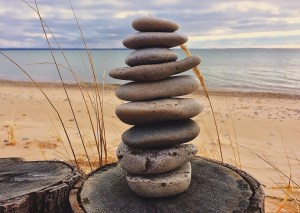
There’s a lot of pressure from all around us to work, be productive, be healthy, be great, be creative, be fantastic, and to do, do, do! It’s no wonder we end up feeling stressed out, depressed, exhausted, and irritable.

What if we were to look at life as a series of choices? For example, when working we make a conscious choice to stop for a while to play. Likewise, when being productive we make a conscious choice to take time to rest. Furthermore, while we eat our fruits and vegetables, we also have a piece of cake every once in a while.

Balance is the key, but you have to choose to pick up the key and use it. Otherwise the door to a joyous and fulfilling life may remain closed to you.

Today I will pick up the key of balance and I will know peace.

Acceptance – A Meditation

There are many things we have no control over: people, places, things, events, the weather and time passing. This can be frustrating, depressing, and even scary.

There are many things we do have control over: how healthy we eat, how much we exercise, how we respond to life events, to people, places and things, and how well we take care of our health – physically, mentally and spiritually – by going to the doctor, taking our meds, meditating and/or praying.

The key is to accept the things we cannot change and to change the things we can. Acceptance does not mean we have to like them. It simply means we need to acknowledge they are reality and we do not have control over them.

Acceptance does not mean we accept unacceptable behavior from others. We have the right to defend ourselves. We are not meant to be doormats, but we must realize that ultimately, we have no control over the behavior of others, only our own.

Acceptance means letting go of tension, worry, and fear. Acceptance is the relaxing of our shoulders, the unclenching of our fists, the releasing of our jaw, the softening of our eyes, and the slowing of our breath. Today, I will accept the things I cannot change and I will know peace.

Calling for Submissions on Homelessness and Mental Illness

Hello! I have been super busy living life!

11140359_892931594101460_3732932980259452221_n

Living life on life’s terms, that is. My children are not well, one physically, the other emotionally. My husband isn’t well physically either. As a result, I have had to take on a lot more responsibilities than I am used to around the house and a lot more outside of the house as well with doctor and therapy appointments. Fortunately, my medications and coping skills are working to keep my bipolar symptoms to a minimum.

It really is possible to live in a “recovery state.” Not that I will ever be cured of bipolar, but I can function for an indiscriminate amount of time without symptoms interfering with my daily living. It is possible for you, too!!!

By the end of the month, I hope to have a new issue of the Turtle Way Journal published. I have received a few poems on mental illness and homelessness already, so I am going to make that this issue’s Special Interest Section. If you have any poems, articles, or essays you would like to submit, please do so as soon as possible by emailing them to me at writeintothelight [at] live [dot] com

Thanks for your support! Please spread the word.

Are You Addicted to Chaos?

argument-238529_640

Today’s post is by Laura Wills. She writes about addiction, which I have stated before is a form of mental illness. After one is no longer using his drug of choice and life is not as chaotic, he may feel uncomfortable with this calmness. I felt this way after I stopped drinking a long time ago. I sometimes feel this way when my bipolar symptoms are at bay. While I am glad that my symptoms subside, life can become a bit boring without them. “Chaos Addiction” may be the reason for this, which Laura explains below.

Falling Out of Comfort and Into Chaos..?

Recovering from addiction isn’t a case of “just” weaning yourself free from substances, alcohol, smoking – or even gambling or shopping. It’s a multi-layered and complex approach that in itself can reveal more about the hidden problems and associations lying underneath.

Very often, people who are in recovery report that as their lives settle down and they begin to take stock, they don’t like the feeling that everything in their world feels as though it is going well, or too smoothly. Many say that they find it difficult to let go of the chaos and dysfunction that surrounds their addiction and therefore seek to try and find it in other areas of their life – such as possibly creating rows with their spouse or partner or keeping troublesome or worrisome situations in their working lives going instead of actively trying to resolve them. This kind of activity has a name – Chaos Addiction and it is something that psychologists are becoming increasingly interested in, in terms of addressing addiction issues.

Many people who find themselves falling into such a problem can usually find at some point in their lives they have been victims of it themselves, perhaps through dysfunctional parenting, constant arguments or even being exposed to addictive behaviors in the home. When they reach maturity they may find themselves adopting the same patterns – especially if they fall into an addiction (however, it does not necessarily mean they will fall into addiction, merely carry on the dysfunctional behaviors they have known all their lives.) For more information on this fascinating subject, you can read on here.

Are you addicted to chaos? Share your thoughts and experiences below.

Call for Submissions

Turtle Way Logo

I am calling for submissions to Write into the Light’s literary-art emagazine, Turtle Way. A new issue will come out in April, so send in your work (i.e., poetry, photos, art, essays, opinion pieces, meditations, quotes, jokes, prose, and stories) asap. Click here for submission guidelines.