Impulsive Decision Making in Bipolar Disorder

block-party-pacific-beach-bike-jumping_w725_h544I try to make healthy decisions regarding my lifestyle. Things like eat well, take my meds, get proper sleep, limit caffeine, don’t drink or smoke. Some things are harder than others.

Today, I threw away my only pack of cigarettes with a new resolve to quit once again. I had plans to download a quit-smoking app to keep track of my days quit and to get active on the online smoking cessation forums which were a great support to me in the past. A half hour later I was retrieving the pack out of the trash and lighting one up.

Yesterday, I decided to start counting calories. My goal is to lose ten pounds. I lost more than this last year and have kept it off, so I know I can do it again, but by last night I was baking, and then eating way too many, chocolate chip cookies. My calories were blown for the day.

Impulsivity is running rampant in my life lately, and quite uncomfortably I might add. Initiating too many impromptu social visits is leaving me stressed and fatigued, but I can’t seem to curbed the impulse to do so. Shopping sprees are rampant under the guise of procuring Christmas presents.

Following these impulsive acts comes guilt and shame, plummeting self-esteem, and the beginnings of self-hatred. Up then down. Up then down. The wonderful life of bipolar disorder.

It helps to remind myself, however, that this cycle is not my fault. It is not a character flaw, a punishment, a sin, or a weakness. It is a biological, chemical, brain disease of which impulsivity is but a symptom.

I found a recent study where researchers looked at euthymic patients with bipolar disorder who were not taking antipsychotic medication and 20 case-matched controls performing a roulette task during functional magnetic resonance imaging. The controls showed higher brain activity during safe reward prospects while the bipolar patients showed higher brain activity during risky reward prospects!

The bottom line is impulsivity is part of bipolar disorder. Accepting this is what we have to do. It does no good to beat ourselves up over something we can’t control. Does this mean I am going to give up trying to quit smoking and losing weight? Absolutely not!

We must never give up trying to get better. We have to keep fighting our symptoms whether it be through medication management, lifestyle changes or both, all the while remembering that they are just that – symptoms, not who we are as a person, but just symptoms of a horrible disease that we didn’t ask for and don’t deserve. A disease that we do have and will continue to deal with the best that we can.

If you enjoyed this article, please consider sharing it.

Meditation: A Cure for Depression and Anxiety?

Neuroscientists now have evidence proving what meditators have been saying for years: Meditation can improve people’s physical and emotional health.

image

Imaging studies show that meditation increases certain areas of the brain responsible for memory and emotion. “Also the parts of the brain that respond the most to stress gets smaller with meditation. This means that anxiety and depression naturally fade with a meditation practice,” according to researchers.

I’ve been doing mindfulness and guided meditations using an app called “Insight Timer” on and off now for about a year, and I definitely notice a difference in my anxiety levels on the days that I meditate versus the days I don’t.  Although on many of the days I meditate, my anxiety level is already low because I tend to have trouble focusing long enough to meditate when my anxiety is high. Go figure!

I do believe the effects of meditation last me a few days and are somewhat cumulative in that sense. So, even when I meditate on a low anxiety day, it could be helping me avoid a super high anxiety day the next day or the day after that.

Meditation hasn’t had an effect on my bipolar depression levels, but maybe it would if I practiced it more consistently since one of my depression triggers is anxiety.  It’s probably worth a try, but to be honest, I have my doubts.

What about you?  Do you meditate?  What benefits has it brought to your health?  Or in light of this recent research, would you consider trying meditation?  Why or why not?

Bipolar Moments – From Diagnosis to Treatment

image

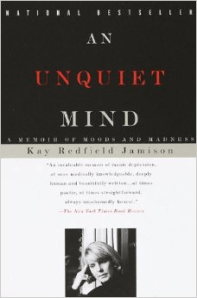
Book Review of An Unquiet Mind

an unquiet mind

I recently read An Unquiet Mind: A Memoir of Moods and Madness by Kay Redfield Jamison. It is an older book, published in 1995. In it, Jamison details her life events beginning in childhood through adulthood with Bipolar I disorder.

She focuses mainly on the mania part of her disorder and on the love relationships of her adult life, as well as on her experiences with lithium, the drug used to treat her bipolar disorder. Much detail is given to her academia life as a psychologist, and to her world travels as woman who never had children, making this memoir a bit inaccessible to me as a homemaker and stay-at-home mom.

Moreover, I have bipolar type II, have never been on lithium, nor have I experienced the extreme manic highs of Bipolar type I disorder, so I couldn’t identify with much of her story, making this book a bit of a disappointment to me and a waste of money for me.

However, if you have Bipolar I and long-term treatment with lithium, you will be able to identify with a lot of what Jamison writes.

Bipolar Moments – Showering

image

When Better is Not Well in Bipolar Disorder and Depression

bipolarLast week, the Depression and Bipolar Support Alliance (DBSA) hosted a forum entitled “Better is Not Well 2014”, in Chicago, IL.  I do not live in Chicago, so fortunately, they streamed the 90-minute event online where I was able to view it from home.

The purpose of the forum was to discuss the issue of raising treatment expectations; of taking patients from simply “surviving symptoms to creating thriving lives.”  The forum moderator and presenter, Allen Doederlein, opened the discussion by listing some of the negative consequences of living with residual mental illness symptoms.

When we’re not all the way well we are:


– at greater risk of relapse
– at greater functional impairment
– more likely to have co-occurring life-threatening conditions (heart disease, diabetes, etc.)
– at greater risk to die by suicide

So, with these negative risks, why do we settle for better instead of striving for wellness? Panelist, Dr. William S. Gilmer, M.D., Clinical Professor in the Department of Psychiatry at Northwestern University, who has specialized in the treatment of depression and bipolar disorder for more than 24 years, said the following.

We have lower expectations because we:


– feel like we’ve won just because we can get out of bed now
– don’t want to set ourselves up for disappointment
– don’t want to rock the boat or lose what we’ve gained by messing with the current treatment regimen
– see a little bit of mood dysregulation as the “new normal”

What does “better but not well” mean?

Dr. Gilmer suggests that lack of “wellness” means that “subsyndromal symptoms” are present. Subsyndromal symptoms are either one or two severe symptoms OR lots of mild ones. Either way, the symptoms do not meet the threshold of being considered an illness state but they are still there, causing discomfort and some impairment.

“Wellness is not just the absence of sickness.” ~ Panelist, Dr. Judith Cook, PhD, an internationally recognized authority on mental health services research

How do we go from better to well?

Panelists’, including two consumers with bipolar disorder, suggestions include:
– utilization of measurement-based outcomes in symptom evaluation to better track wellness levels
– better optimization of medication dosage and therapy frequencies
– not settling for better; striving for wellness
– discussing wellness with your psychiatrist; if he or she will not listen find a new one

What is your definition of wellness?  What would it look like or does it look like in your life?

If you this post was of interest to you, please share it.

Why Being a Hermit Doesn’t Work

We all have problems. Let’s face it: humans are problems. We create problems, we live problems, we solve problems, we prolong problems, we complain about problems, we hate problems, some of us love problems, we…well, you get the idea.

Whether your problems come from within such as in the case of an illness, or from something outside of you, such as your demanding boss, research shows that we are more likely to better cope with our problems with some kind of support from peers who have been in the same situation as we face.

support

By coping better I mean we may live happier lives, have less stress, increased psychological well-being, and decreased negative symptoms.

Now, while you might not join a support group to deal with an a-hole of a boss, you may want to consider one if you deal with chronic mental or physical illnesses, bereavement issues, weight loss or addiction issues, or if you are a caregiver for someone who is ill or dependent.

In one study (1), 82% of the 129 members of the Manic Depressive and Depressive Association were hospitalized before joining the support group. After joining, only 33% reported any hospitalizations.

In a substance abuse study (2), 180 participants with high self-help (Alcoholics Anonymous, Narcotics Anonymous) attendance rates used alcohol and/or cocaine less than half as much as did those with low self-help attendance. In a second study (3), in the 18 months following treatment, the more days the patient attended Alcoholics Anonymous self-help meetings, the longer their abstinence lasted.

In a bereavement group study (4), 197 widows and widowers over age 50 who participated in self-help groups experienced less depression and grief than the 98 nonparticipants if their initial levels of interpersonal and coping skills were low. (If their interpersonal and coping skills were high they still benefited after eight weeks of participation.)

I have been attending support group meetings for alcoholism for the past 10 years and believe I would not have remained sober for this long without doing so. Currently, I am participating in an online smoking cessation support group that is proving to be an invaluable part of my quit program. And let’s not forget this wonderful blogging community, which I consider to be a large part of my mental health “support group.” Thank YOU for that!

The greatest thing in the world to hear while you’re in the depths of your struggles, whether it is with an addiction, a mental illness, the loss of a loved one, or just a crappy day is, “I understand how you feel. I’ve been where you’re at. You are not alone.” And that, my friend, is why hermithood is not for me.

If you enjoyed this article, please consider sharing it.

Resources:

(1) Kurtz, L. F. (1988). Mutual Aid for Affective Disorders: The Manic Depressive and Depressive Association. American Journal of Orthopsychiatry 58(1): 152-155.

(2) McKay, J. R., A. I. Alterman, et al. (1994). Treatment Goals, Continuity of Care, and Outcome in a Day Hospital Substance Abuse Rehabilitation Program. American Journal of Psychiatry 151(2): 254-259.

(3) Pisani, V. D., J. Fawcett, et al. (1993). The Relative Contributions of Medication Adherence and AA Meeting Attendance to Abstinent Outcome for Chronic Alcoholics. Journal of Studies on Alcohol 54: 115-119.

(4) Caserta, M. S. and Lund, D. A. (1993). Intrapersonal Resources and the Effectiveness of Self-Help Groups for Bereaved Older Adults. Gerontologist 33(5): 619-629.

Is Drug Addiction a Mental Illness?

the-church-of-hank-williams

I’ll get right to the point: YES, drug addiction is a mental illness. Let me explain the two main facets of drug addiction. First, there is the physical aspect of it – the physical craving for the drug because of the person’s chemical dependency upon the drug. In the case of alcohol, one will find that once they take a drink they will not be able to control the amount of alcohol they consume thereafter no matter how hard they try.

Second, there is the mental aspect of it, which is the obsession of when, how, how often and how much of the drug one can get. The addict’s thoughts are consumed with obtaining and retaining access to their drug of choice. It is a form of obsessive-compulsive disorder in my opinion, and it is lethal. It is not a moral shortcoming. It is not a choice. It is not a sin. It is not a lack of discipline or will-power. It is a mental illness!

According to the National Institute on Drug Abuse, drug addiction qualifies as a mental illness because “addiction changes the brain in fundamental ways, changing the person’s normal hierarchy of needs and desires and substituting of new priorities connected with procuring and using the drug.”

While the addict may have crossed the line into non-choice when it comes to using his drug, he does always have the choice of whether or not to get treatment for his illness/addiction, just like one who has bipolar or schizophrenia can choose to get help for his illness or not.

However, as in the case with many mental illnesses, sometimes a primary symptom is that which tells the person that they don’t have the illness. This symptom is called denial, and unfortunately, it can delay treatment long past what is appropriate or safe for the individual.

Resources:

National Institute on Drug Abuse
Alcoholics Anonymous
Al-Anon
Narcotics Anonymous

Treating Multiple Mental Illnesses

number

With my multitude of diagnoses and their over-lapping symptoms, I often wonder which illness has a hold on me. Am I on edge because I am hypomanic or anxious? Am I depressed because of a hormonal change/Bipolar issue or because my husband is working long hours/Borderline (BPD) issue? Am I exhausted because I’m depressed, because I’m not sleeping well due to anxiety, or because I’m overwhelmed with the kids being off school for the summer (BPD thing again)? You see my dilemma?

I know from experience what is usually causing my symptoms. Right now, I know I am dealing with anxiety because change is hard for me and with this being the first week the kids are home from school there has been a big change in my daily activities.

I also know from past experience that anxiety exhausts me physically, and that being physically exhausted makes me feel depressed. I say “feel” depressed because I know that it is just a feeling – I am not clinically depressed as in I need a medication change (yet.) First, I’d like to give myself time to adjust to the new schedule, and see if the fatigue and anxiety subside on their own.

I came across a study that looked at the interactions of Borderline Personality Disorder (BPD) with Major Depressive Disorder (MDD) and Bipolar Disorder over the course of 10 years. They found that BPD impacted major depression remission and relapse rates, and vice versa, but argued for the treatment of the BPD as a priority.

BPD and Bipolar Disorder remission and relapse rates, on the other hand, were largely independent of one another except for one area: bipolar type II lengthened BPD’s time to remission. (Wouldn’t you know that would be my case!) BPD did not affect bipolar mood swings. The study suggested that BPD and Bipolar be treated as independent disorders.

I do have rapid cycling bipolar and I also have borderline personality traits, so both on a physiological and psychological level I am battling quick fluctuations. Can anyone else relate to this? How do you cope with over-lapping symptoms from multiple diagnoses?

Weekend Mental Health Writing Prompt – Fathers

20140606-212721.jpg

In honor of Father’s Day, the writing prompt this weekend is none other than – fathers! Write about your father or grandfather or someone who was or is like a father to you. How did he shape you into the person you are today? In what ways, both positive and/or negative, does he affect your mental health? What is a good memory you have of him? What else would you like to write about him?

Link your response back to this post so others can find it or feel free to comment below. And Happy Father’s Day to all the fathers out there!