Seven Ways to Cope with Indecision and Mental Illness

hand-457335_960_720

Indecision and Mental Illness

I am feeling the nudge to write a post here today, and as I was sitting here pondering what topic I should write about many things related to mental health came to mind: stress of the upcoming holidays, social media addiction, shopping compulsion, and comorbid diseases to name a few.  My mind fluttered back and forth and back again around each topic.  I couldn’t decide.  Suddenly, I realized this is how I’ve been living my days for the last several years, in a state of indecisiveness.

Interestingly, indecisiveness is a symptom of many psychiatric conditions such as depression, anxiety disorders, psychosis and personality disorders.  Knowing this makes me feel better because at least there is a reason for my difficulty with making decisions versus it merely being a character flaw.

There are times, however, when I can make decisions, but they are usually impulsive and harmful, such as deciding to buy too many clothes or starting too many projects at one time.  For the most part, however, I either don’t trust my own decisions because of my history of impulsivity or I can’t make decisions and often defer to others to decide many things for me, such as what to watch, where to eat, what to buy, etc.

One of the biggest factors contributing to my indecisiveness is my fear of not knowing which choices I make will bring on symptoms of my illnesses.  I know what many of my triggers are after years of dealing with them, but not all of them.  Moreover, the ones I do know are inconsistent; sometimes they trigger symptoms, sometimes they don’t.  Therefore, deciding to risk it or not is always a difficult thing to do.

For me, indecisiveness also comes from lack of motivation.  I normally function at a mild level of depression, so making choices means taking action which is challenging at times.  More than even starting the action or task is finishing it.  I usually lose energy, mentally or physically, before completing tasks, and knowing this about myself prevents me from ever starting them.

This all sounds very depressing, and I guess looking at it from an objective point of view it is.  Honestly, though, I am so used to it I barely notice it is a problem.  I am sure if I found a way to deal with it I might rise out of my mild level of depression.  Maybe you all have some tips you can share?

Here’s what some experts have suggested:

woman-687560_640

7 Ways to Cope with Indecision*

1. Forget About Always Appearing Smart

I can definitely relate to this.  I think my perfectionistic tendencies and fear of failing keep me from deciding to do things.

2. Trust Your Gut

I find this is often the only way I can make decisions, albeit impulsively.

3. Beware of the Paradox of Choice

The fewer the options, the easier the choice.  Therefore, maybe limit how much advise you seek.

4. Prioritize Your Demands and Fears

Make sure you have healthy boundaries established with the people in your life.

5. Act in a Moral and Sincere Manner

Do the right thing.

6.  Don’t Over Analyze Things

Act, evaluate results, make adjustments and move on.

7.  Flip a Coin

When all else fails, call it heads or tails.

*Source: Seven Ways to Conquer Indecision

5 Tips on How to Love Yourself When You Have a Mental Illness

woman-570883_640-1

This morning, my middle schooler brought to my attention a quote she heard on social media:

“Can anyone say they truly love themselves?”

I asked her if she loved herself and to my relief she said, yes, except for how tall she is. 🙂  Then she asked me if I loved myself.  My breath caught in my throat as years of self-hatred flashed before my eyes, and I hesitated for half a second before giving her my best answer:  I love my true self, but I don’t like everything that I do.

I prayed she didn’t notice my hesitation, because I want to lead by example and instill a good sense of self-worth within her, but apparently, and thankfully, she already has that despite my poor self-esteem and overall dissatisfaction with my appearance and behaviors.

I went on to explain to her that our “true selves,” our spiritual selves, are different from our human selves, and that I really love my true self, the pure, perfect side of me.  It is the human side, the ill side, that is hard to like sometimes.  She looked at me like I was crazy, because, well, she’s only twelve and I was getting way too philosophical for her.  🙂

Our conversation got me thinking though, about how much I dislike myself because of my mental illness, its symptoms and subsequent behaviors – the depression that leads to crying and laying in bed all day, the irritability that leads to losing my temper with the kids, the anxiety that leads to extra work for my husband to do.  All of these things surmount to loads of guilt and self-hatred, thereby perpetuating the symptoms which caused the behaviors in the first place.

How do those of us with mental illness combat this destructive thinking; disrupt this negative thought cycle?

How do we come to love ourselves despite our mental illnesses?

Here are some ideas:

  1. Change our thoughts – I know, I know – easier said than done.  A long time ago, I even wrote about how impossible it can be, (How Positive Thinking Can Be a Crock) but try replacing negative thoughts with positive ones.  For example, instead of thinking, “I’m such a loser,” say to yourself, “I am a kind, thoughtful person with friends who enjoy my company.”  If you can’t bring yourself to think of positive thoughts, that is ok.  Don’t stress over it.  Just being aware of the negative ones is a good start.
  2. Keep a thought journal and write down any negative thoughts you have that day in one column.  In a second column challenge those thoughts.  For example, when my daughter said she didn’t like the fact that she is taller than everyone else, I said, “Even though being tall is an advantage when playing volleyball?”  She said, “Oh yeah, I guess I do like being tall then.”
  3. Make a list of positive attributes in your journal.  If you have a hard time coming up with things, ask friends or family members for ideas.  Keep adding to the list and refer to it often.
  4. Practice, practice, practice.  Just like learning any new skill or playing a sport, you won’t get good at this over night.  It will take lots of repetition before it becomes more automatic.  I have been keeping a thought journal for almost two months now and I still have a hard time catching myself in the midst of self-criticism, but this brings me to the final tip:
  5. Don’t give up!  Keep trying.  Have faith that it will work and that your joy and peace of mind are worth it.

And remember:

You are not your mental illness.

Your true self is perfect.

Mental Illness and Seasons of Change

fall-1072821_640

It is the season of fall here in the northern hemisphere; a time where the temperatures cool down, the leaves change colors and begin to drop from the trees, the grass goes dormant, and the days grow shorter and shorter.  For a lot of people with mental illness, it is a time of depression.  The professionals call it “Seasonal Affective Disorder (or SAD.)”

I have SAD, although with the mood stabilizers I am currently on for my bipolar disorder, my seasonal depression is not as severe as it once was.  I used to use a light box to help combat my winter depression, but I haven’t needed it for years now.  And last winter, I didn’t experience a depressive episode at all, which was a miracle!  I made up for it this summer, but that is a different story.

While thinking about the changes that fall brings outside, I was also meditating on some changes I need to make within myself.  I thought letting go of behaviors and beliefs which are limiting my good physical and mental health was, in a way, symbolic of the way trees let go of their leaves.

I know I want to set healthier boundaries with some of the people in my life.  I tend to do too much for others while neglecting my own needs which leaves me mentally drained and physically ill.  The belief driving this behavior is that I must be perfect to gain other people’s approval and that I need other people’s approval to feel good about myself.  This belief causes me much anxiety, and when I fail, which I often do because no one is perfect, I feel depressed.

It is helpful for me to identify these types behaviors, and more importantly, the beliefs driving them, because they really do affect my mental health as much as the chemical imbalances in my brain do.

It is only by changing the conversation I have with myself in my head about what I believe that I am going to be able to successfully change my unhealthy behaviors.  I have to plant the seeds of new, healthier beliefs this fall and let old behaviors die off this winter which will hopefully give birth to greater peace of mind come spring (or earlier – but I’m doing a metaphor thing here.) 😉

What unhelpful beliefs can you let “fall” away, and what negative behaviors might die as a result?


6 Foods to Avoid to Fight Daytime Fatigue and Other Things I Should Be Doing

sleep-55792__180

Anyone who has a depressive disorder knows the agony of bone-deep, stuck-in-molasses, ever relentless fatigue.  Day in and day out, dragging yourself around with that hundred pound weight chained to your ankle; barely being able to make it out of bed to use the bathroom let alone eat.

Or maybe your fatigue is not that extreme.  Maybe it is more of an annoyance; decreasing your motivation; making everything seem like more of an effort.  Either way, there are several foods that actually increase sleepiness that you may want to avoid during the day.

6 Foods to Avoid To Fight Daytime Fatigue

  1. Bananas because they are high in magnesium – a muscle relaxant that will make you tired
  2. Red meat because a lot of energy goes into digesting its high fat content, thereby making you feel tired
  3. Cherries because they are high in melatonin, a natural sleep aid
  4. White bread, including pastries, white rice, pasta, muffins, and processed foods because all of the flour and sugar in them causes drowsiness, and their lack of fiber causes them to break down too quickly to offer a constant flow of energy
  5. Fish like salmon, halibut, and tuna because the body uses the Vitamin B6 in them to make melatonin (the sleep hormone)
  6. Turkey because it is high in tryptophan, which is an amino acid that increases serotonin levels, a relaxing brain neurotransmitter

These foods shouldn’t be avoided all together.  Consuming them in the evening just might be a better idea.


Another way to combat fatigue is to maintain a healthy weight, which is something I struggle with.  I’d be happy to lose about 15 pounds.  I’d be ecstatic to lose 20.  Something that came across my mailbox today caught my attention, and I wanted to pass it along because its suggestions for weight loss are, in general, I think, good for overall mental health, too.

belly-2473__180

7 Ayurvedic Secrets for Weight Loss

Ayurvedic Medicine is one of the world’s oldest medical systems, originating in India more than three thousand years ago.  The idea behind these “secrets” is that as you become healthier over all, the weight will naturally come off.

  1. Sleep from 10pm to 6am every night
  2. Exercise for 45-60 minutes vigorously, sometime between 6-10am each morning
  3. No snacking; three meals a day only
  4. Include all six tastes at each meal (sweet, sour, salt, spice, bitter, astringent. See resource link below for food examples.)
  5. Eat your largest meal at noon; finish your last meal 2-3 hours before bed
  6. Sip hot water or tea throughout the day
  7. Practice meditation

I think I could do some of these.  I am darn close to a few – sleeping from 11pm-6:30am already; having only one snack, at night after dinner, which I am planning on cutting out starting tonight.  I do hot coffee throughout the day, does that count?  I practice meditation, but not regularly.  Could easily change that.  Largest meal at noon won’t happen because family dinner is in the evening.  However, by cutting out the nighttime snack I will have finished my last meal well before the three hour mark before bed.

I think including all six tastes at each meal will be a huge challenge because I eat so little for breakfast and lunch.  Literally, for breakfast I have a bowl of Cheerios. That is a sweet food, according to the list.  This morning, however, I did have a swallow of citrus juice, which is a sour taste, and I do have my coffee every morning, which is a bitter taste.  I could have popped a few grapes in my mouth for an astringent taste.  Maybe this will be easier than I thought.  The hard one is the exercising.  I have a huge aversion to it.  Sigh.  Baby steps.

What do you think of these secrets?  If you try them and they help you lose weight or just make you feel better, let me know.

Resource links:
https://chopra.com/ccl/7-ayurvedic-secrets-for-weight-loss

Bipolar Triggers

There are external stimuli that trigger my bipolar symptoms. Strict schedules, time constraints, too much time out of the house, and extended family gatherings all wreak havoc on my mood stability. My anxiety sky rockets and, if left too high for too long, it triggers a major depressive episode.

Seasonal changes affect my moods as well. Each spring, without fail, as the grass turns green and tree buds bloom, so does my hypomania.  It lasts for about four to six weeks, fading out as the end of the school year approaches, which brings me to another trigger: change.

Each summer when my young children start summer break and each fall when they return to school, a mood shift occurs. Summer is unpredictable. It could be a return to stable from the hypomania of spring.  It could be a dip into depression.  In the fall, it is always a fall into depression. 

I’ve learned to manage my triggers by avoiding them whenever possible or at least by limiting them when appropriate. I say no to, not all but, most volunteer work. I limit my social commitments.  I get extra rest when pushed beyond what is comfortable for me.

I have to protect my mood at all costs. Does it always work?  No. Some things in life are just unavoidable. I have to cook and clean and run my kids places and show up for some commitments.  Sometimes these things all fall on the same week or day, and that’s when things get scary. That’s when I close my eyes and hope for the best while using the skills I learned in DBT (Dialectic Behavioral Therapy) as best I can. 

If my mood doesn’t bounce back after my external world settles down, that’s when I talk to my doctor about a medication change.  It happens a lot, and that’s Ok.  I have to stay on top of this bipolar thing. It’s a matter of life and death.

What are your triggers?  How do you deal with them?

A Review of “Joy,” the Chatbot Mental Health Tracker

joy

Joy is a chatbot created by product designer and front end developer, Danny Freed, using artificial intelligence. It made its debut on Facebook Messenger three weeks ago. Freed was inspired to create Joy after his friend died by suicide, in hopes that it will encourage people to open up about their mental health.

Joy initiates daily contact with the user, asking how he is feeling or how his day was. Joy attempts to detect a user’s mood and keeps a record of what it finds so the user can track his emotional state over time. Joy also gives the user suggestions on how to cope with the symptoms he may be experiencing.

I have been using Joy for nine days now. When I installed Joy in Facebook Messenger, which is the only way to use Joy thus far, it started off by asking me how I felt over the last thirty days. Then it asked me to write my first journal entry. It was a pleasant start to my relationship with Joy.

The very next evening, I received a notification from Messenger indicating a message sent from Joy. She said, “Happy Monday. How’s it going? Did anything unexpected happen today?” I told her about my day, and she accurately assessed that I was “stressed out,” and asked me if I wanted a tip for how to feel less stressed. I said, “Yes!”  She proceeded to give me a link to a guided meditation on YouTube she said would help, and it did!

(You’ll notice that I am now referring to Joy as a “she.” The natural language of Joy’s programming makes it feel like you are talking to a real person at times; it is easy to personify “her.”)

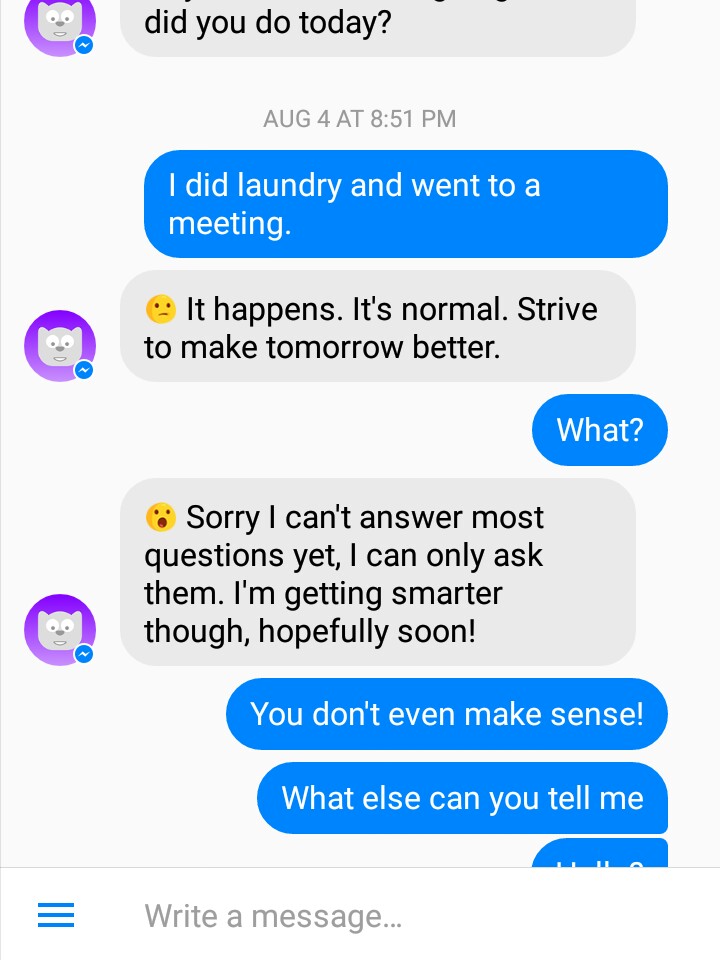
There were times it was obvious, however, that she was not a real person, such as evident in the conversation below:

Joy conversaion

I was anxious everyday, and everyday she gave me a YouTube guided meditation to do. While helpful at times, the repetitive response became exasperating. One day, when she asked me if I wanted a tip on how to feel less stressed, knowing that her response would be yet another guided meditation, I replied, “No.” She said, “No problem. Hope you find a way to reduce stress! Let me know if I can help.”  Another time, I said, “Yes, but I don’t want a guided meditation.”  She gave me one anyway.  disgusted

She had some helpful suggestions when I told her I was depressed. She told me to get outside because sunlight boosts serotonin which helps regulate mood. I told her it was nighttime and asked what else I could do. She said she can’t answer questions yet, but hopefully soon. She told me later on in the week to get eight hours of sleep to help with my depression. I thought about telling her it was the middle of the day, but decided against it. wink

Her suggestion when I told her I was angry was to “let go.”  That’s a tough one.

Over the course of the week, she tracked my moods and upon my request, created a mood report (see below.)

mood report

She also recorded my journal entries and recalled those in report form as well.

Freed has plans for updates and improvements as feedback and data comes in from product use. Overall, it’s a good start to a potentially useful program for those in fairly good mental health to those with minor issues. For those of us with debilitating mental illnesses, however, this program is not sensitive enough to capture the more severe symptoms of some of our illnesses.

Have you heard of or tried Joy?  If you try it, let me know what you think.

What if I Have Bipolar Plus Anxiety Disorder?

window-view-1081788_960_720


Anxiety is often a symptom of bipolar disorder.  In a depressive or manic state, a person can feel excessive worry, panic, paranoia, agitation, irritability, and experience social phobia.  The level of anxiety can fluctuate along with the bipolar mood states.

It is also possible to have bipolar disorder with a separate diagnosis of an anxiety disorder, where a person’s worries and fears can go on for months or even years, even when the bipolar moods are stable.  There doesn’t have to be a reason for the anxiety.  It could just be a sense of something bad about to happen at any moment.

There are several types of anxiety disorders including:

Panic Disorder

People with panic disorders have unexpected panic attacks with intense fear, shortness of breath and fast heartbeats; some may sweat and feel like they are choking or are going to faint or die.  They feel like they are out of control when having a panic attack.  They often fear they will have another one, and avoid the places where they have had them before.

Intense fear and highly noisy, over stimulating, chaotic environments, such as a kid’s birthday party, can bring on a panic attack for me.  I used to get them at work, at sporting events, at the grocery store, and recitals.  So, improvements have been made, but I do still suffer from them.

Social Anxiety Disorder

People with social anxiety disorder fear being around others, where they are worried about being embarrassed or judged or rejected.  They have a hard time talking to others and making eye contact.  They often feel like running away in social situations.  They may sweat, shake or get nauseous when called upon to interact with others.

My social anxiety manifests itself in many of the ways described above, however, I am not always completely shy as one might imagine someone with social anxiety being.  Quite the opposite, I will often overcompensate and come off a bit brash.  I blame that on my bipolar impulsivity.

So, I actually take an fast, but short-acting, antianxiety medication prior to social events to, one, decrease my chances of having a panic attack, and two, to give my prefrontal cortex a bit more time to censor what I want to say.

Generalized Anxiety Disorder (GAD)

People with GAD tend to worry about things, both large and small, but out of proportion to the impact of the event.  They can’t let go of the worry, and worry about being worried all of the time.  They feel restless and can’t relax.  They are fatigued, irritable, have trouble sleeping, and are tense to the point of having sore muscles and headaches and/or GI problems.  They have a hard time concentrating or their mind often goes “blank,” except when carrying every option out to its possible negative conclusion.

Even when their worries don’t completely consume them they still feel anxious for no apparent reason.  I function most frequently in this state, always worried about my safety and that of my children, and feeling like something bad is going to happen at any moment.


Do I Have An Anxiety Disorder or Is It Part Of My Bipolar?

Of course, any disorder has to be properly diagnosed by a professional, which I am not.  To find out for sure if you have an anxiety disorder, talk to your physician.  From what I have learned and personally experienced, however, the difference between having one of these anxiety disorders in addition to bipolar disorder and having “bipolar anxiety” alone is that with anxiety as a symptom of bipolar, one may experience a mix-mash of random symptoms from each disorder.  Having a separate anxiety disorder, on the other hand, requires the person to fit the diagnostic criteria for said disorder.

For panic disorder, for example, one would have to have recurring attacks, and be fearful of having future ones to the point of avoiding situations and places where he or she have had them in the past.

For GAD the person would have to have:

“excessive and unrealistic worry over a period of at least six months…associated with at least three of the following symptoms:

  • Restlessness
  • Fatigue
  • Difficulty concentrating
  • Irritability or explosive anger
  • Muscle tension
  • Personality changes, such as becoming less social”

Source: http://www.webmd.com/anxiety-panic/guide/anxiety-attack-symptoms

If a person is only experiencing some of the symptoms of anxiety but not enough to fit the diagnostic criteria of having the disorder, then he or she merely has anxiety as a symptom of the bipolar disorder.

The reason this is important is because they are treated in different ways.

Treatment

If a person has bipolar disorder with anxiety symptoms, as his or her bipolar disorder came under control, the anxiety symptoms would most likely subside.  If he or she has bipolar disorder and an anxiety disorder, the moods may be stable but the anxiety may still be disabling.

The problem with having both bipolar disorder and an anxiety disorder is that while anxiety disorders alone are normally treated with antidepressants, it is often unwise to give someone with bipolar an antidepressant since it may trigger a manic episode.  Many physicians treat people with these comorbid conditions by addressing the bipolar symptoms first with mood stabilizers and other “bipolar medications.”

Once the person’s mood is stabilized, then any remaining anxiety symptoms are addressed in any number of ways depending on the doctor and patient’s plan.  Since antidepressants could have detrimental effects on the course of one’s bipolar disorder, atypical antipsychotics are often used to treat anxiety disorders in those with bipolar.

Psychotherapy or Cognitive Behavioral Therapy and relaxation training are always safe bets.  If antidepressants are tried, careful monitoring for any hypomania or mood cycling must be done.  Benzodiazepines are effective in relieving many anxiety disorder symptoms, but they are habit-forming and must be prescribed with caution.

Do you have comorbid bipolar and anxiety disorders?  How has this mix played out in your every day life?

Sources:
Mayo Clinic
National Institute of Mental Health (NIMH)
Psychiatric Times


Another Brain Region Linked to Bipolar Disorder

For several years, neuroimaging studies have noted differences in the prefrontal cortex and limbic areas (which includes the hippocampus) of the brains of individuals with bipolar disorder compared to those without bipolar disorder.  Now, a new study is suggesting that the genes and proteins found in the striatum are linked to bipolar disorder as well.  The striatum acts as a reward pathway and helps to regulate motivation among other things.

Brain

“Our finding of a link between bipolar disorder and the striatum at the molecular level complements studies that implicate the same brain region in bipolar disorder at the anatomical level, including functional imaging studies that show altered activity in the striatum of bipolar subjects during tasks that involve balancing reward and risk,” said Research Associate Rodrigo Pacifico, who was first author of the new study.

Researchers are hoping that their findings will lead to the development of diagnostics and treatments.

The more research I find, such as this, the more I realize that bipolar is so much more than a “chemical imbalance.” It truly is a brain disorder. Our brains are anatomically and molecularly different from those without bipolar. It’s so much more than a simple lack of neurotransmitters (i.e., serotonin, dopamine, etc.)

We should all be proud of the progress we’ve made considering what we are up against. Thank goodness for continued research which will hopefully lead to improved treatments. Let’s continue to do our part by taking care of ourselves as best as we can and never giving up!

Source: The Scripps Research Institute

What to Do About Bipolar Disorder and Stress

ache-19005_960_720
Bipolar and Stress

We all have stress. Can’t avoid it. Can’t get rid of it. Might as well learn how to deal with it. Right? Wrong. Let’s make a list of our stressors. Pretty long list, eh? I bet we can avoid or get rid of at least a few of them if we really wanted to. It may take some finagling, help from others and a lot of courage, but I bet we can do it.

The problem is we may be too worried about what other people think or hurting someone’s feelings or feeling too guilty to make the changes necessary to reduce our stress. We may be too proud to ask others for help or too embarrassed to let others see how we really are, so we put on our masks and act like everything is fine, thereby increasing our stress.

For those of us with bipolar disorder, this is especially dangerous because stress can trigger mood episodes. According to an article on PsychCentral, “people with bipolar disorder are more prone to stress than the average population.”

Along with the danger of triggering mood episodes, chronic stress can over-produce stress hormones resulting in “chemical imbalances and physical changes in parts of the brain already vulnerable due to bipolar disorder. The prefrontal cortex shrinks, leading to emotional instability, self-regulation problems, and mood changes.”

So, you can see how important it is to reduce the amount of stress in your life! My doctor told me just that and my response was: “Yeah, right! I’ll just get rid of my kids then.”

There are some stressors we obviously cannot eliminate. However, I have made changes to reduce my stress, even with my kids like making them do more for themselves and not saying yes to every activity they want to do.

I go to support group meetings for people in recovery from drugs and alcohol. In one meeting, there is this one lady in particular who causes me a lot of anxiety whenever I see her. So, I now avoid that meeting even though I like the other people who go there. The stress is not worth it to me. There are too many other meetings I can go to where I don’t feel stressed.

I say “no” to seventy-five percent of the parties I am invited to because of my social anxiety. I know I offend some people because I say no so much, but I don’t care. I used to force myself to go and then get panic attacks while there and sick with anxiety and migraines for days afterwards. I have to eliminate the stress that I can from my life in order to stay balanced and healthy.

Let’s not forget about positive stressors, too. A recent weekend trip to see friends, while fun, left me feeling exhausted and overwhelmed. I came home and crashed for two days straight just to mentally and physically recuperate from lack of sleep and over-stimulation. Fortunately, my husband helped around the house so I could do this.

Before I understood how bipolar works, I would have continued trying to do everything for and with the kids until I crashed into yet another severe depression. I also would have returned from that weekend trip and went on with my week like any “normal” person would have. Only unlike a “normal person,” by week’s end, I would have been in full manic irritability and dissociation. This would have lasted for a week or two followed by a depressive episode lasting for who knows how long. Now, I know good self-care is the key to managing my stress.

I don’t know about you, but I don’t want to play shrinky-dink with my brain, so

My basic plan when dealing with stress is this:

  • Identify my stressors
  • Get rid of them when possible (e.g., say, “No.”)
  • Avoid them when possible (e.g., remove self from situation)
  • Ask for help
  • Practice good self-care (eat well, sleep well, take meds, have routine)
  • This goes without saying, but I’ll say it anyway – when I am stressed I write.  (Guess you know how I am feeling right now.) 😉

What helps you deal with the stress in your life?

Unexpected Moments- A Meditation

sisters-1328070_960_720

So many things in life come to us unexpected – sickness, heartache, disappointments. Many good things come as well like surprises, laughter, and joy. In each unexpected moment lies the essence of life. These are the moments that cannot be planned or constructed in any way. These moments are gifted to us by the sheer forward propulsion of living, of being alive.

When entrapped in the snare of mental illness, we are still within an unexpected moment of life – a moment of sickness. We are still in the forward propulsion of living because mental illness is not static. It is a dynamic phenomenon that must be ridden out like a surfer on an ocean wave. With treatment and time, a solution may be but a moment away.

In those unanticipated moments of darkness and despair, I will keep an open mind so that I may hear an unexpected message of hope and I will know peace.