Hopping Along – a poem

It’s Holy Week
as I reflect
on the cotton-tailed
one

who is quiet,
cautious
and reserved;

who likes to stay
in the shadows,
and frightens easily;

who burrows
under blankets
of green earth,

protected, yet
so vulnerable
while keeping close
to her family.

3 Words About Bipolar Hypomania

20130326-224844.jpg

Who can relate? Comment below…tell me I’m not alone. How does mania manifest itself in your life?

How To Eliminate Regret and Worry From Your Mind

20130322-225704.jpg

Soon I will be posting mental health discussion topics and questions on the Facebook page. Be sure to Like it. Thank you.

I AM Not a Mental Illness

20130321-233156.jpg

Please likeWrite into the Light on Facebook. Thank you.

You Are Not Your Mind

20130317-232046.jpg

Never Give Up

I write these for you…….and me.

cropped-img_4114

Please like Write into the Light on Facebook. Thank you.

Now On Facebook

Hey, Guys. I just set up a page for Write into the Light on Facebook. Please go there now and LIKE. Thanks so much!

xo,
WIL

Co-occurring Disorders

juggle

I found this helpful article on causes and solutions of having dual diagnoses (substance abuse AND mental illness.) I wanted to bring to you some interesting facts and highlights. To view the handout in its entirety click here to download the Hazelden Foundation’s pdf.

Factors involved in the development of psychiatric disorders:

1. Vulnerability (determined by genetics and early life experiences)
2. Stress (challenges faced in life)

Factors that can help reduce symptoms and relapses:

1. Abstaining from alcohol and drug use

“Avoiding alcohol and drug use can reduce biological vulnerability in two ways. First, because substances affect the brain, using alcohol or drugs can directly worsen those vulnerable parts of the brain associated with psychiatric disorders. Second, using substances can interfere with the corrective effects of medication on vulnerability. This means that somebody who is using alcohol or drugs will not get the full benefit of any prescribed medications for his or her disorder, leading to worse symptoms and a greater chance of relapses.”

2. Take prescription medications according to your doctor’s orders
3. Learn to use positive coping skills
4. Develop social support systems
5. Engage in meaningful activities

Which factors are you incorporating into your life to help reduce symptoms and prevent relapses? Which factors do you need to add?

The Sucky Part of Dual Diagnoses

juggle

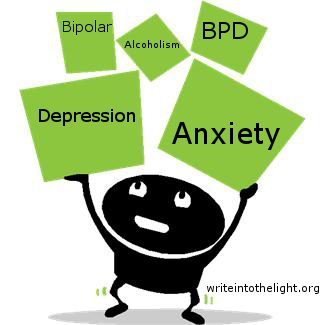
Like many of you, I have multiple mental illness diagnoses…ones in which symptoms overlap to the extent that I don’t know what I am experiencing sometimes.

Is it anxiety or hypomania? I tend to go into cleaning frenzies during both states. Is it depression or hypomania? I tend to neglect my self-care during both states? Is it bipolar or borderline personality disorder symptoms? Frequent mood swings and anger outburst appear upon exacerbations of both of these illnesses for me.

How do you distinguish between different diagnoses? Does making the distinction really matter?

For me it does…anxiety means a change in that med while mania means a change in another one. My doctor increased my antidepressant at one point in order to treat (what we thought was) my anxiety, and the change threw me into rapid cycling bipolar symptoms (a very scary place to be.)

Cycling mood swings calls for a look at my mood stabilizer OR maybe I just need to refocus my efforts on using DBT skills (Dialectical Behavioral Therapy skills are clinically effective for treating Borderline Personality Disorder.)

Depression and self-pity…is it clinical – meaning do I need a med adjustment or is it something that a few extra counseling sessions or sobriety support group meetings would alleviate?

I am grateful there are so many avenues of support and treatment for all of my disorders – counseling, support groups, skills, medications (both traditional and alternative.) However, knowing which one needs to be tweaked here and there can be quite frustrating.

Have you ever experience the frustration of having two or more diagnoses whose symptoms overlap? How do you distinguish between them or how do you cope with it? Please share. I really could use your insight.

Thanks.

hugs,
Wil