Four C’s of being a Parent with a Mental Illness

parent mental illness

I was driving my ten-year-old daughter home from her friend’s house one cool summer night. The car windows were down, and the wind whipped through our hair as the radio blasted one of her favorite songs. We sang along at the top of our lungs, laughing and screaming with delight. Just behind the excitement in her eyes I saw a touch of hesitation, a worry, and rightly so. I was manic, and while she didn’t know specifically about my bipolar disorder, on some level she recognized the signs, and it scared her…

Read the rest of my guest post today over at Dispatches From the Mad Parenthood Front.

Facebook and Its Negative Effect on Mental Health

no facebook

I gave up my personal Facebook activities last week. Note: You can still find me on Write into the Light’s Facebook Page, but, I have pushed my personal profile account to the side. Deleted the app from my phone. Haven’t checked status updates in five days which means…

I have no clue whose kid just made the honor roll, who is having a bad day at work, what everyone is having for dinner tonight, or how everyone’s nieces and nephews are doing in sports. I haven’t seen one photo-quote, inspirational or humorous. Not one recipe or emoticon from friends of friends whom I would probably not even recognize if I ran into them at the grocery store.

Top 3 Reasons to Give Up Facebook

1. The People in My House are More Important to Me than Those I Hardly Ever See

It is hard enough to filter through the minute details of my own life, let alone those of acquaintances. And that is what the majority of those on my friends list are: acquaintances. Knowing of their daily happenings makes no difference in the quality of my life. On the contrary, it wastes time and energy that would be better spent on the people with whom I actually live and on my own mental health.

2. I am a Highly Sensitive Person

Since I am a highly sensitive person who picks up on and internalizes the emotions of other people, I was finding myself being negatively effected by the sad events being shared on Facebook, from political cries to save the abused animals posts to the depressing events in people’s personal lives.

I am not saying that I don’t want to hear about the death of a dear friend’s father or the house fire of another. What I am saying is that I would rather hear about it through a phone call than on Facebook. As far as the political and social movement stuff – I don’t watch the news so as to avoid those things, so I definitely don’t want to see them in my Facebook feed.

And if you are that old friend from high school whom I haven’t seen in twenty years who has lost your job or been in an accident or gotten a divorce…I feel bad for you, but if it wasn’t for Facebook I wouldn’t even know what you look like now, let alone about the happenings in your life. No offense.

3. My Mental Health is More Important than Knowing Things About People I Haven’t Spoke to in Decades

My decision to cut Facebook out of my life came shortly after a high school classmate committed suicide, which triggered many negative emotions in me due to losing a very close friend to suicide two years ago.

After hearing about my classmate on Facebook, I grieved for a week, barely able to get out of bed some days. Grieved not really for my old classmate since I haven’t seen him in 15 years, but for my close friend all over again. It was very difficult to go through, and it could have spiraled my depression out of control.

(Thankfully, I did some mindfulness practice, talked to several people about my feelings, prayed, and wrote about it here, knowing that as long as I didn’t ignore or cover up my feelings, they would eventually pass and I’d feel better. And they did.)

However, I realized that if it wasn’t for Facebook, I never would have heard about my classmate’s suicide, and therefore, would have avoided a week of suffering because of it. No one called me, no one even directly told me about his suicide. I merely happened upon it by accident…on Facebook.

So, no more Facebook for me. How does Facebook affect your mental health? Have you ever even thought about its effects on you?

New Issue of Turtle Way – a journal for those with Mental Illness

Happy Friday, everyone! A new issue of Turtle Way was just published. Read it here, and have a beautiful weekend.

Turtle Way Logo

Mental Illness and the Power of Now

TPON_Cover_LG

I’ve been reading the book, The Power of Now by Eckhart Tolle, for about ten months. I can only read a few pages at a time before it becomes too intense in its truths and suggestions for my brain to handle. It’s a fascinating book that gives me a lot to think about and meditate on.

Today, I wanted to share a quote from the book that particularly related to my mental illness symptoms, and maybe to yours as well. It has to do with surrender, which Tolle explains is an inside job, meaning that while you can take action to try to change the overall situation if you want to, you still need to accept the tiny segment of Now that is occurring.

If I equate this with my mental health symptoms, I may need to accept, for example, that I am feeling sad and agitated at the present moment. Overall, I have been feeling this way for the past week, which I can work towards changing by reporting these symptoms to my doctor, praying, writing, and focusing on what tasks I have in front of me – in the Now.

It is when I do not accept or surrender to my current feelings that I become even more depressed and agitated to the point of wanted to harm myself in some way. (Some people may cut, abuse drugs or alcohol, overeat, engage in risky behavior, or attempt suicide.)

So, here is the quote:

“Non-surrender hardens your psychological form, the shell of the ego, and so creates a strong sense of separateness. The world around you and people in particular come to be perceived as threatening. The unconscious compulsion to destroy others through judgment arises, as does the need to compete and dominate. Even nature becomes your enemy and your perceptions and interpretations are governed by fear. The mental disease that we call paranoia is only a slightly more acute form of this normal but dysfunctional state of consciousness.

Not only your psychological form but also your physical form – your body – becomes hard and rigid through resistance. Tension arises in different parts of the body, and the body as a whole contracts. The free flow of life energy through the body, which is essential for its healthy functioning, is greatly restricted. Bodywork and certain forms of physical therapy can be helpful in restoring this flow, but unless you practice surrender in your every day life, those things can only give temporary symptom relief since the cause – the resistance pattern – has not been dissolved.”

Aren’t these ideas amazing to ponder? I can relate to all of them. I have a fear of people hurting me; feel like I am in competition with everyone; filled with fear of natural disasters, or some harm coming to one of my children. Fear rules my life, and I don’t want it to.

Physically I am usually in pain – tension headaches, muscle cramps, migraines, neck stiffness, clenched jaw, exhaustion, etc. I exercise, go to the chiropractor, and get massages to try to relieve my physical pain. The results are always temporary, lasting a day or two at the most.

I must work on surrendering to what is in the Now. I must work on dissolving the “resistance pattern.” But, how? I will keep reading and let you know what I find.

What are your thoughts on this? How do you work on surrendering in your daily life?

Bipolar Disorder and Memory Problems

memory

A recent study in Bipolar Disorder found that those with the disorder had prospective memory impairments compared to those without the disorder. Prospective memory is the ability to plan to do something and later remember to carry it out.

Just today my prospective memory failed me as I had plan to make a crock pot meal for supper which involved combining the ingredients and turning the crock pot on low five hours ahead of when we planned on eating. I became engaged in other tasks, namely watching TV and stressing about getting my house cleaned for company this weekend, before I realized it was four hours before dinnertime and I hadn’t even started preparing the crock pot meal!

Now this isn’t as tragic as forgetting to take an infant out of the car before going into the store, or leaving a scalpel inside a patient after surgery, which are both examples of failing prospective memory, but it was annoying nonetheless.  Next time I will set the timer on my microwave to remind me when I should have started the meal prep.

Here are some other ways to improve your prospective memory:

  • use checklists
  • write out when and where you intend to complete a future task
  • use calendar alerts on your cell phone to remind you to do a task
  • do not put off important tasks for later; do them now
  • write the reminder on your hand
  • tie a string around your finger
  • leave a note on the door you exit everyday

How do you remember to do something later?

River of Emotions

river

When I am feeling sad or depressed, or anxious and afraid, my first instinct is to get rid of these emotions either by doing something unhealthy like smoking or overeating, or something productive like cleaning the house or exercising. The goal in both cases is to block out the emotion; to ignore it; to purge it from my system; to eradicate it.

What if rather than trying to kill the emotion, I sat with it; let it flow through and around me, believing all the while I am safe, because it is my actions, not my emotions, that have the potential to harm me.

I find that when I do this, the emotion tends to dissipate on its own. It’s as if giving it recognition somehow facilitates its disappearance.

Today, I will acknowledge the emotions within me. I will validate their existence, keeping in mind that feelings are not facts. They cannot harm me. Like a river they will flow towards me, through me and then out of me, and I will know peace.

The Do’s and Don’ts of Mental Health Blogging

newspaper

The National Institute on Mental Health (NIMH) news reports that over 50 research studies worldwide have found that the type of news coverage on suicides makes a difference in the influence it has on the suicide rates of its viewers who are at risk for it.

The longer and the greater the coverage of a suicide story, the more likely vulnerable individuals may commit suicide themselves. Explicitly describing the suicide method and using dramatic headlines are big no-no’s as well.

However, “careful” reporting on suicides can change public misperceptions and dispel myths, thereby encouraging those at risk to seek help.

What does this mean for us mental health bloggers?

blogger

While our audience may not be in the millions like network television stations or hundreds of thousands like those of major newspapers and internet news sites, I think we should still be responsible in how we describe our own struggles with mental illness and our own thoughts on self-harm and suicide.

I have seen bloggers on either end of the spectrum here. On one hand, some are overly cautious and post “trigger warnings” on most everything they write or vlog about. Trigger warnings are little blurbs that say, “Hey, I am getting ready to write or talk about something that could trigger negative symptoms in you, so continue reading/listening at your own risk.”

I like trigger warnings because sometimes I am in a bad space with my own mental illness symptoms to where listening to someone talk about their self-abuse habits or their detailed thoughts of suicide may cause me some sleepless nights at best, and at worst, may tempt me to entertain such ideas myself.

I have also come across bloggers who write about or post vlogs about the details of their childhood abuse, which is a huge negative trigger for me. For those of you who put trigger warnings on this type of stuff, I thank you, because I will skip those parts entirely. Maybe some people want to read about it; maybe it helps others, but for me it triggers panic attacks. In my opinion the details of such events are best dealt with in therapy or within your own private journal.

Now, I am not proposing we don’t mention the fact that the abuse happened at all. If it did, it is important to validate the horrifying affect it had on us. I am merely suggesting that the minute details of the specific acts themselves be kept out of public posts. To me, the negative effects on the reader far outweigh any positive ones.

Another hot topic in the mental health blogosphere is self-harm behaviors. Some bloggers not only name the behavior, which is acceptable in my opinion, but go on to detail why they do it, what it feels like and looks like, and the thrill or release or whatever “positive” thing they are getting out of it. I understand it works for many people (I used to be one of those individuals; I get it!) However, sensationalizing it, as the NIMH states, only encourages others to do it, and that is not what we want.

Based on NIMH’s suggestions, I propose that we bloggers:

  • Help reduce the risk of contagion by including posts or links to treatment services, warning signs and suicide hotlines.
  • Include stories of hope and recovery; information on how to overcome self-harm behaviors and cope with suicidal thinking.
  • Focus on solutions rather than just the problems.

What suggestions would you have for mental health bloggers?  Share them in the comment section below.

For a side-bar list of suicide warning signs you can include in your posts visit http://reportingonsuicide.org/warning-signs-of-suicide/

If you or someone you love is suicidal you can call the U.S. National Suicide Prevention Lifeline at 1-800-273-TALK (8255), a free, 24/7 service that can provide support, information and local resources. For those outside the U.S., visit http://www.suicide.org/international-suicide-hotlines.html to find suicide hotlines in your country.

How to Deal With Complex PTSD Triggers

Dealing with PTSD Triggers

Current Symptoms

Racing thoughts. Obsessive compulsive behaviors, such as cleaning, organizing, exercising. Increased negative coping behaviors, such as overeating, smoking, and drinking. Physical pains, such as upset stomach, migraines, muscle aches and fatigue. Early morning waking. Increased irritability. Forgetfulness. Tightening chest. Racing heart rate – literally hearing my heart pounding in my ears. Shallow, rapid breaths. Dissociation or feelings of having an “out-of-body” experience.

These are common occurrences for those of us with anxiety disorders. This week, I experienced all of them (except for the drinking.) Only after forcing myself to sit down long enough to do some journaling was I able to identify the source of my anxiety…

Triggers

There is always a cause for anxiety. Did you know that? It just doesn’t come because “we are crazy.” There is always a root cause, and it serves me well to sit down and face the fear of finding out what it is, because once I realize what is causing it, I can deal with it, and the symptoms will subside.

Sometimes finding the cause isn’t as simple as it can be with straight-forward Post Traumatic Stress Disorder symptoms, which are caused by specific events such as accidents and natural disasters. Sometimes the events are actually an accumulation of events occurring over a period of months or years, where the person is subject to long-term, repeated trauma as in the case of child abuse. In such cases, the term “Complex PTSD” is often used even though it is not officially a diagnosis included in the Diagnostic and Statistical Manual of Mental Disorders (DSM) (at the time of this writing.)

This week my three-day anxiety attack which culminated into a full-blown panic attack was triggered by a few things. First of all, I shared my BPD story last weekend, which set my anxiety level higher than normal, but in and of itself didn’t cause me too much stress. However, add that to the fact that on two different occasions last week I unexpectedly ran into different individuals with whom I went to high school, and then the kicker was an unplanned evening of looking through my high school yearbooks (at my daughter’s request.) She wanted to see what her dad and I were like back in the day, and I didn’t think twice about taking a trip down memory lane. Next time I will.

Past Trauma

High school was a very traumatic time for me. My parents’ alcoholism was at its peak; dysfunction and emotional neglect were at an all time high in our home. Memories of those years are clouded with my own drunken states filled with self-harm behaviors and untreated bipolar and borderline personality disorder symptoms.

Before going to bed that evening, I made a passing comment to my husband about feeling a little anxious after looking through those yearbooks, and then I thought nothing more of it.

Three days later, I had my first panic attack in many, many months.

After quickly figuring out the cause of my anxiety (due only to writing about my feelings, which is why “Write into the Light” is my mantra) I began to ask myself many questions:

  • Is knowing the cause of my anxiety enough to make it go away?
  • Do I need to worry that these memories triggered me the way they did?
  • Is this a sign that I need to work out some more stuff in therapy with my counselor, who I haven’t needed to see in six months now?
  • Does this mean I am not healed all the way like I thought I was?

Healthy Coping Skills

I was a mess at this point. But, here are the skills I used to cope with my state of mind at the time. My hope in sharing these is that it will give you some ideas to try when you find yourself experiencing extreme anxiety.

First, I left messages for two friends who I knew would understand, and I also left a message for my therapist.

Next, I tried sitting with and observing my feelings, thoughts, and body sensations without judgment; trying not to push anything away nor hang onto anything. Just noticing and observing as if I was an outsider looking in.

I tried soothing myself by rubbing scented lotion on my arms and hands, which didn’t help much.

Then I decided to call my doctor to get an emergency refill of my PRN anti-anxiety medication. Luckily, the pharmacy filled it in ten minutes, and also luckily, my husband was due home for his lunch break and was able to pick it up on his way.

While waiting, I wrapped myself in a warm blanket and sat in a fetal position on the couch in a quiet room. This helped calm me immensely.

I also said some simple prayers.

I took my medication at the same time my therapist called back. After telling her what happened, she said that I might need to try some “exposure therapy” meaning that I look at the yearbooks when I am in a good place emotionally and mentally, and even then only for a short time, and maybe not with my young daughters.

Integration

I made the comment to her that I thought I had gotten past this part of my life, that my negative feelings about it were gone. She said they are always going to be there; that the goal is not to get rid of the bad memories, which is impossible, but to instead integrate them. Integration is the goal. (Integration: The organization of the psychological traits and tendencies of a personality into a harmonious whole.)

She also said that I should try to dig up a few good memories from that time. She said they are probably there, but are just overshadowed by the bad ones. At first I didn’t think she was right, but then I made a conscious effort to get out of my black and white/all or nothing thinking, and started thinking dialectically – where good and bad memories can co-exist. And guess what? She was right!

Discussion Questions:

When you’re anxious do you dig deep to find out what the root cause is? It may be something more than what it appears to be on the surface.

What physical symptoms do you have when you are feeling anxious? Do you take the time to sit and notice your body’s sensations and your mind’s thoughts during these times? Why or why not?

Subscribe to this blog by entering your email in the top right side bar above or if you’re on the mobile site, leave a brief comment and check the box that says, “Notify me of new posts via email.”

You can also connect with me on Twitter @writeintolight

Until next time…

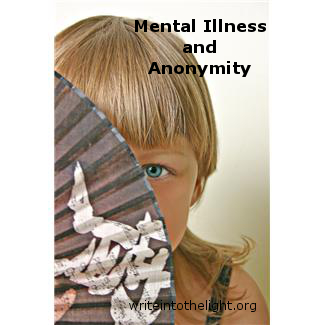
Mental Illness and Anonymity

mental illness anonymity

There are several reasons why I choose to maintain my anonymity on this mental illness blog.

The primary reason is to avoid hurting family members. Many of my mental illness symptoms, in particular my anxiety, are directly related to childhood events. For me to publicly identify myself while revealing facts about my upbringing would be harmful to my family members.

Even though there are benefits of adding my face and real name to the content of this blog, such as increased credibility and to support the cause for an end to the mental illness stigma, I will not do so at the expense of another’s peace of mind and privacy.

The second biggest reason I choose to maintain my anonymity is to maintain a sense of humbleness to my message. Money, power, and prestige are not my goals. Sharing what it is like to have mental illnesses and what I do to strive for healing and peace are my goals, with the hope to inspire others struggling with similar issues.

My greatest wish is that no one ever feels like they are unique. People need to know that they are not the only ones who feel the way they do, that someone else understands how they feel and has gone through what they are going through.

Another reason I choose to maintain my anonymity is because just as I would not announce at my job or highschool reunion or in a restaurant, whether it be to a large group of people or just one or two persons I didn’t know well, that I have a mental illness, why should I do so online?

I tell those whom I am close to, to those whom I trust, when the time is appropriate and when I believe it would be helpful to the situation. Anything beyond this is not necessary for me.

This is what works for me. It may be the same, or different, for you. What are your thoughts on online anonymity and mental illness?

Healing From Our Past

20130414-180402.jpg

Please Like Write into the Light on Facebook.