Mental Illness is a Surmountable Obstacle

~ Guest post by Jackie Cortez

According to the World Health Organization, 1 in 4 people suffer from mental illness. And while treatment is available, it’s often underutilized.

For many people, mental illness can be something that troubles them periodically in life but never something that incapacitates them. For others, mental illness can be completely debilitating. What’s important is recognizing mental illness and treating it with the best approach for people so they may live healthy, productive lives.

Inner turmoil

While there are social stigmas attached to mental illness, it is the self-stigma that can be the most dangerous to a person’s overall well-being. A person with a mental illness may feel ostracized from his peers and turn to outward or inward destructive behaviors to cope. These may materialize as bursts of aggression, depression, or isolation or as reckless actions including sexual promiscuity and alcohol abuse and drug abuse. A mental illness makes it difficult to see past the negative aspects of today to the bright and beautiful possibilities of tomorrow. It is estimated that more than 90% of suicides are committed by persons with a diagnosable mental disorder. Approximately half of these individuals will struggle with drug or alcohol abuse before their death.

Physical self-care

If you’re struggling with a mental illness, you should take extra care to take care of yourself. Stress takes a toll on the body and can cause headaches, insomnia, muscle tension, upset stomach, and fatigue. These symptoms’ impact can be lessened through protecting your physical health. It is easier to maintain good mental health habits when your body – your foundation – is strong.

It is important to exercise daily. This may be done individually or in a group setting as exercise provides the body with natural stress relief hormones. Maintaining a balanced diet devoid of processed foods, including sugars, additionally goes a long way toward whole-person health. Sleep is essential and most adults require between seven and nine hours each night; a brief 30 minute nap in the early afternoon can also offer a person with a mental health disorder a bit of a boost. Most importantly, drugs and alcohol should be avoided completely as, despite common belief, these substances actually exacerbate stress and depression.

A mental illness will not go away overnight. However, many people find they are less affected when they practice these good mental health habits:

Avoid guilt

Negative emotions happen and it is important not to dwell on them or pass judgment. Understand that it is how you react to these emotions that matters. Recognize them but don’t get caught up in the moment.

Pay attention to the positive

Even in your deepest, darkest hour, positive things are going to happen in your day. It could be as small as a glimpse of the mountains or fresh ocean breeze. When they happen, pause and enjoy. It may help to keep a journal and write down one good thing that happens each day. You can go back and read about your happy days when you’re feeling sad or stressed to remind yourself that not everything in life is bad.

Find strength in numbers

There are virtually countless support groups in every city in every state for people struggling with mental illness. You can perform a quick online search for groups in your area. Know that you cannot solve things on your own and there are people out there who, like you, are dealing with invisible and taboo issues. Spending time with others will not only help you get things off your chest but will keep you connected to the world around you.

If you or someone you love is dealing with a mental health issue, such as depression or drug abuse, get help. Always remember there is no shame in asking for assistance from others, be they medical professionals, family, or friends. Tomorrow is a new day and a new opportunity to look at the world with a fresh set of eyes.

man-2254752_640

~ Jackie Cortez works with The Prevention Coalition to identify and highlight resources on every aspect of substance abuse, ranging from prevention to addiction treatment. Her mission is to use her writings to help prevent drug and alcohol abuse.
Neuroimaging Shows Increased Activity in Bipolar Mania

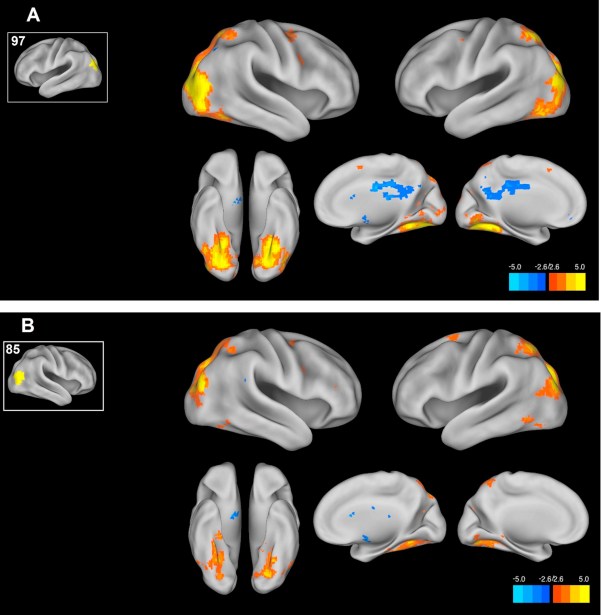
In a recent study looking at the difference in neural activity between persons with bipolar I disorder who were experiencing mania, those with bipolar I disorder who were experiencing euthymia or a normal, non-depressed mood, and persons who did not have any psychiatric disorders and were considered “healthy controls,” researchers found some significant differences in two brain networks.

The first was in the Dorsal Attention Network (DAN), which is a group of regions in the brain that plays a large role in our internally motivated goals using our visual attention and short-term memory processes. In other studies, increased activity is evident in the DAN after the presentation of cues indicating where, when, or to what participants should direct their attention.

In this study, those individuals who were manic had significantly higher levels of activity in their DAN compared to the euthymic group and the healthy control group, possibly explaining the often apparent hyperattention, arousal and emotional response of those experiencing mania to external stimuli.

gr1_lrg

This figure shows the increase of connectivity in mania (A) versus euthymia (B)

The second brain area assessed was the Default Mode Network (DMN), which is a group of brain regions that shows a lower level of activity when we are working on a particular mental task like paying attention, but higher levels of activity when we are doing more generic thinking tasks such as daydreaming, recalling memories, guessing about the future, monitoring the environment, speculating on the intentions of others – just thinking without any task-oriented goal in mind. Recent research has begun to find connections between the DMN and mental illnesses like anxiety and depression. Also, meditation is thought to be related to the DMN, which may be why its influence in well-being is significant.

Of particular note in this study, was the fact that those with bipolar disorder in a euthymic state showed hypo-connectivity in the dorsal nodes of their DMN compared to the mania group and healthy control group. The mania and healthy control groups showed the same connectivity.

Does this mean that the euthymic group was more relaxed, less worried about the past and future, less concerned about their surroundings and the behaviors of others than the other groups? Even the “healthy” group? I don’t know. The researchers didn’t comment on what this particular finding suggested other than the fact that this dorsal node is the exact location that corresponds to the target for transcranial magnetic stimulation (TMS) for the treatment of depression, even though they made sure to reiterate the fact that the euthymic group was not depressed.

The researchers pointed out the fact that their study’s results contribute to a body of growing evidence that points to bipolar mania as a behavioral pathology due not to circuit disruption but rather increased coherence (connectivity).

As far as the hypo-connectivity of the dorsal nodes of the DMN in the euthymic group goes, the researchers were not sure if this was due to a compensatory mechanism of the disorder trying to right itself or if it was in fact still part of the diseased state.

Of note:
– Diagnosis was determined using the Structured Clinical Interview for the DSM-IV (SCID)
– Limitations of the study included a small sample size of 23 manic, 24 euthymic, and 23 healthy controls.
– There were no significant differences in participant age, sex, and medications

Resources:

Differential brain network activity across mood states in bipolar disorder
Dorsal Attention Network
Dorsal and Ventral Attention Systems
Know Your Brain: Default mode network

Bipolar Brains Are Different

In the largest MRI study on people with bipolar disorder, researchers determined that the areas in the brain that control inhibition and emotion – the frontal and temporal regions – are significantly different than those of people without the disorder.

170502084119_1_900x600

Bipolar patients tend to have gray matter reductions in frontal brain regions involved in self-control (orange colors), while sensory and visual regions are normal (gray colors). Credit: Image courtesy of the ENIGMA Bipolar Consortium/Derrek Hibar et al


The study was led by the University of Southern California Stevens Neuroimaging and Informatics Institute at the Keck School of Medicine of USC: ENIGMA (Enhancing Neuro Imaging Genetics Through Meta Analysis). It involved 76 centers and included 26 different research groups around the world.

The researchers measured the MRI scans of 2,447 adults with bipolar disorder and 4,056 healthy controls. They also looked at the effects of commonly used prescription medications, age of illness onset, history of psychosis, mood state, age and sex differences on cortical regions.

Some findings suggest those with a history of psychosis have greater deficits in the affected regions and there are “different brain signatures in patients who took lithium, anti-psychotics and anti-epileptic treatments.”

Further studies will look at how these medications affect brain measures and subsequently, modify symptoms and outcomes for patients. “This new map of the bipolar brain gives us a roadmap of where to look for treatment effects,” said Thompson, an associate director of the USC Stevens Neuroimaging and Informatics Institute at the Keck School of Medicine.

I think it is awesome that they are finding physical proof of the nature of bipolar disorder; that it is not some myth or personality flaw or weakness or moral shortcoming. These findings can give people like me the validation they need to know that they are not “crazy,” but ill.

Having a brain that doesn’t function normally is no different than having a pancreas that doesn’t function normally (diabetes.) Granted the symptoms of bipolar disorder may affect those around the individual more severely than the symptoms of diabetes, but the general analogy is still the same.

Article source

Suicide in the Media: Getting it Done Right

I have been reading thoughts online and hearing opinions in real life regarding a Netflix series about a teenage girl who dies by suicide, and what questions this show raises about the media’s responsibility for portraying triggering, and even instructional, scenes on how to take one’s own life. In response to this, I would like to refer to an article published this month by Lisa Firestone, PhD in Psychology Today, who states:

“Guidelines on the media’s portrayal of suicide include never glamorizing or sensationalizing it in any way, period. Specific means for suicide should not be shown or related. Any depiction of suicide should include a story of a survivor who is living proof that the suicidal state can be temporary…In addition, any discussion of suicide should include resources for people who may be in crisis or are worried about someone they know. Media should also include a list of warning signs for suicide, which can help people identify when someone’s at risk.”

I feel distressed because so many preteen and young teenagers are watching this show, which has a ‘MA’ rating. I feel worried because kids with mental illness are watching this and possibly being triggered into self-harming behaviors and emotional anguish. And, God forbid, if any one of them is moved to end their life because this show’s message gives them the final reason to do it or the final way to go about doing it.

Don’t get me wrong…It is important to talk about suicide to raise awareness and get people who need help to open up and reach out for it, but like Firestone says, without following proven recommendations on how to report on suicide, “we risk contributing to individuals’ suicide risk and even creating contagion, especially among teens.”

Please remember, the suicide state is often passing and temporary. It can be a trance-like state that can leave people with diminished awareness of the fact that if they wait things out they may regret even considering suicide at all. Many people who have made serious attempts often have these types of regrets, because like everyone says, things do get better. Nothing ever stays the same. Don’t give up just before things change!

Warning Signs of Suicide

(from the American Association of Suicidology)

  • Talking about wanting to die.
  • Looking for a way to kill oneself.
  • Talking about feeling hopeless or having no purpose.
  • Talking about feeling trapped or being in unbearable pain.
  • Talking about being a burden to others.
  • Increasing the use of alcohol or drugs.
  • Acting anxious, agitated or recklessly.
  • Sleeping too little or too much.
  • Withdrawing or feeling isolated.
  • Showing rage or talking about seeking revenge.
  • Displaying extreme mood swings.

Resources:

Is a Daily Routine or An Unstructured Lifestyle Better for Our Mental Health?

When I was first diagnosed with Bipolar Disorder my life was in complete chaos. I had a job that didn’t have set hours, with responsibilities and a caseload that changed on a daily basis. Plus, I had three small children with a husband who worked varying hours, including nights and weekends. My days were anything but routine.

Fast forward five years later, and I am a stay-at-home mom with a set routine of getting up at the same time every morning to get the kids off to school, work on house chores during the day as my illness allows me, rest in the afternoon, be there for the kids when they get home from school and in the evening for school and sport events. I also take my medications on a routine schedule and go to bed around the same time every night.

Researchers have demonstrated that routines can help those with bipolar disorder by balancing their sleep/wake cycles. Routines can also help those with anxiety by making daily activities more manageable and predictable. Routines help us get more stuff done by keeping us on task, thus providing more time for rest and relaxation, which is also good for mental health. And routines give us a sense of control over our lives since we get to choose what we include in them.

I do find that as my illness symptoms creep back into my life, there is sometimes the need for flexibility in my routine. For example, when I am fatigued from depression, I may spend more time in bed and less time on chores.

However, after a few days or a week, my routine usually kicks back in and I am at least doing a little bit each day. While I might not feel motivated to engage in my routine, my routine motivates me to get things done, because it is what I am used to doing. It doesn’t feel right to not do it.

What about you?  Are routines good for your mental health or do you prefer an unstructured lifestyle?

3 Easy Ways to Practice Gratitude for Better Mental Health

woman-571715_640

This week, in the United States, we are celebrating Thanksgiving Day. It is meant to be a day spent with family, being grateful for all we have in life. Often times, however, it is a stressful week filled with mad-dashes to crowded grocery stores, hours of cleaning and cooking, homes filled with obnoxious relatives, and the start of over-indulgent spending sprees as Christmas shopping begins the day after Thanksgiving, infamously dubbed as “Black Friday.”

It can also be an extra lonely and depressing day for those who have lost loved ones around this time of year or for those who do not have anyone with whom to celebrate or share a Thanksgiving Day meal.

In both scenarios, scientific evidence shows that practicing gratitude can improve a person’s mental health, in terms of both anxiety and depression. Now, this doesn’t mean that being grateful one day or one week a year is going to make a difference. It is something that has to been done consistently over time.

Why Gratitude is Good for our Mental Health

The evidence is in:  Across three experiments by Robert Emmons and Michael McCullough (2003,) they found evidence that practicing gratitude leads to positive emotional and interpersonal outcomes.  A 2006 study in Behavior Research and Therapy found that Vietnam Veterans who practiced gratitude had lower rates of Post Traumatic Stress Disorder.

Robert Emmons, the world’s leading researcher on gratitude, has this to say:

  • “Gratitude allows us to celebrate the present. It magnifies positive emotions.
  • Gratitude blocks toxic, negative emotions, such as envy, resentment, regret—emotions that can destroy our happiness. There’s even recent evidence, including a 2008 study by psychologist Alex Wood in the Journal of Research in Personality, showing that gratitude can reduce the frequency and duration of episodes of depression and protect people from stress.
  • Grateful people are more stress resistant. There’s a number of studies showing that in the face of serious trauma, adversity, and suffering, if people have a grateful disposition, they’ll recover more quickly.  I believe gratitude gives people a perspective from which they can interpret negative life events and help them guard against post-traumatic stress and lasting anxiety.
  • Grateful people have a higher sense of self-worth. I think that’s because when you’re grateful, you have the sense that someone else is looking out for you—someone else has provided for your well-being, or you notice a network of relationships, past and present, of people who are responsible for helping you get to where you are right now.

Once you start to recognize the contributions that other people have made to your life—once you realize that other people have seen the value in you—you can transform the way you see yourself.”


3 Easy Ways to Start Practicing Gratitude Today

  1. The easiest way to start practicing gratitude is to wake up each morning and think of three things for which you are grateful. Name them off in your head and spend just a moment thinking about each one, and then go about your day.  Or think of them at night before you go to sleep, pondering each one as you drift off into dreamland.
  2. One of the most effective ways to practice gratitude, according to Emmons, is to keep a gratitude journal. Write five things for which you are grateful in it once a week.
  3. Finally, act grateful. Don’t just think it and write it, but say it to others, smile, say thank you, give freely in gratitude, write thank you notes, give hugs. A grateful spirit is contagious and attractive. People will be drawn to you, and you will know a new peace and calm in your life.

Personally, I am grateful for this opportunity to write about gratitude. I feel good just writing about it for you. I am grateful that you are there to read it.

I am also grateful for this week and all that it holds for me. I am grateful for my day of rest today and the busyness of tomorrow and Thursday. I am grateful for my new holiday outfit and my dog and the quiet in my home at the moment.

What are you grateful for?

Seven Ways to Cope with Indecision and Mental Illness

hand-457335_960_720

Indecision and Mental Illness

I am feeling the nudge to write a post here today, and as I was sitting here pondering what topic I should write about many things related to mental health came to mind: stress of the upcoming holidays, social media addiction, shopping compulsion, and comorbid diseases to name a few.  My mind fluttered back and forth and back again around each topic.  I couldn’t decide.  Suddenly, I realized this is how I’ve been living my days for the last several years, in a state of indecisiveness.

Interestingly, indecisiveness is a symptom of many psychiatric conditions such as depression, anxiety disorders, psychosis and personality disorders.  Knowing this makes me feel better because at least there is a reason for my difficulty with making decisions versus it merely being a character flaw.

There are times, however, when I can make decisions, but they are usually impulsive and harmful, such as deciding to buy too many clothes or starting too many projects at one time.  For the most part, however, I either don’t trust my own decisions because of my history of impulsivity or I can’t make decisions and often defer to others to decide many things for me, such as what to watch, where to eat, what to buy, etc.

One of the biggest factors contributing to my indecisiveness is my fear of not knowing which choices I make will bring on symptoms of my illnesses.  I know what many of my triggers are after years of dealing with them, but not all of them.  Moreover, the ones I do know are inconsistent; sometimes they trigger symptoms, sometimes they don’t.  Therefore, deciding to risk it or not is always a difficult thing to do.

For me, indecisiveness also comes from lack of motivation.  I normally function at a mild level of depression, so making choices means taking action which is challenging at times.  More than even starting the action or task is finishing it.  I usually lose energy, mentally or physically, before completing tasks, and knowing this about myself prevents me from ever starting them.

This all sounds very depressing, and I guess looking at it from an objective point of view it is.  Honestly, though, I am so used to it I barely notice it is a problem.  I am sure if I found a way to deal with it I might rise out of my mild level of depression.  Maybe you all have some tips you can share?

Here’s what some experts have suggested:

woman-687560_640

7 Ways to Cope with Indecision*

1. Forget About Always Appearing Smart

I can definitely relate to this.  I think my perfectionistic tendencies and fear of failing keep me from deciding to do things.

2. Trust Your Gut

I find this is often the only way I can make decisions, albeit impulsively.

3. Beware of the Paradox of Choice

The fewer the options, the easier the choice.  Therefore, maybe limit how much advise you seek.

4. Prioritize Your Demands and Fears

Make sure you have healthy boundaries established with the people in your life.

5. Act in a Moral and Sincere Manner

Do the right thing.

6.  Don’t Over Analyze Things

Act, evaluate results, make adjustments and move on.

7.  Flip a Coin

When all else fails, call it heads or tails.

*Source: Seven Ways to Conquer Indecision

Mental Illness and Seasons of Change

fall-1072821_640

It is the season of fall here in the northern hemisphere; a time where the temperatures cool down, the leaves change colors and begin to drop from the trees, the grass goes dormant, and the days grow shorter and shorter.  For a lot of people with mental illness, it is a time of depression.  The professionals call it “Seasonal Affective Disorder (or SAD.)”

I have SAD, although with the mood stabilizers I am currently on for my bipolar disorder, my seasonal depression is not as severe as it once was.  I used to use a light box to help combat my winter depression, but I haven’t needed it for years now.  And last winter, I didn’t experience a depressive episode at all, which was a miracle!  I made up for it this summer, but that is a different story.

While thinking about the changes that fall brings outside, I was also meditating on some changes I need to make within myself.  I thought letting go of behaviors and beliefs which are limiting my good physical and mental health was, in a way, symbolic of the way trees let go of their leaves.

I know I want to set healthier boundaries with some of the people in my life.  I tend to do too much for others while neglecting my own needs which leaves me mentally drained and physically ill.  The belief driving this behavior is that I must be perfect to gain other people’s approval and that I need other people’s approval to feel good about myself.  This belief causes me much anxiety, and when I fail, which I often do because no one is perfect, I feel depressed.

It is helpful for me to identify these types behaviors, and more importantly, the beliefs driving them, because they really do affect my mental health as much as the chemical imbalances in my brain do.

It is only by changing the conversation I have with myself in my head about what I believe that I am going to be able to successfully change my unhealthy behaviors.  I have to plant the seeds of new, healthier beliefs this fall and let old behaviors die off this winter which will hopefully give birth to greater peace of mind come spring (or earlier – but I’m doing a metaphor thing here.) 😉

What unhelpful beliefs can you let “fall” away, and what negative behaviors might die as a result?


6 Foods to Avoid to Fight Daytime Fatigue and Other Things I Should Be Doing

sleep-55792__180

Anyone who has a depressive disorder knows the agony of bone-deep, stuck-in-molasses, ever relentless fatigue.  Day in and day out, dragging yourself around with that hundred pound weight chained to your ankle; barely being able to make it out of bed to use the bathroom let alone eat.

Or maybe your fatigue is not that extreme.  Maybe it is more of an annoyance; decreasing your motivation; making everything seem like more of an effort.  Either way, there are several foods that actually increase sleepiness that you may want to avoid during the day.

6 Foods to Avoid To Fight Daytime Fatigue

  1. Bananas because they are high in magnesium – a muscle relaxant that will make you tired
  2. Red meat because a lot of energy goes into digesting its high fat content, thereby making you feel tired
  3. Cherries because they are high in melatonin, a natural sleep aid
  4. White bread, including pastries, white rice, pasta, muffins, and processed foods because all of the flour and sugar in them causes drowsiness, and their lack of fiber causes them to break down too quickly to offer a constant flow of energy
  5. Fish like salmon, halibut, and tuna because the body uses the Vitamin B6 in them to make melatonin (the sleep hormone)
  6. Turkey because it is high in tryptophan, which is an amino acid that increases serotonin levels, a relaxing brain neurotransmitter

These foods shouldn’t be avoided all together.  Consuming them in the evening just might be a better idea.


Another way to combat fatigue is to maintain a healthy weight, which is something I struggle with.  I’d be happy to lose about 15 pounds.  I’d be ecstatic to lose 20.  Something that came across my mailbox today caught my attention, and I wanted to pass it along because its suggestions for weight loss are, in general, I think, good for overall mental health, too.

belly-2473__180

7 Ayurvedic Secrets for Weight Loss

Ayurvedic Medicine is one of the world’s oldest medical systems, originating in India more than three thousand years ago.  The idea behind these “secrets” is that as you become healthier over all, the weight will naturally come off.

  1. Sleep from 10pm to 6am every night
  2. Exercise for 45-60 minutes vigorously, sometime between 6-10am each morning
  3. No snacking; three meals a day only
  4. Include all six tastes at each meal (sweet, sour, salt, spice, bitter, astringent. See resource link below for food examples.)
  5. Eat your largest meal at noon; finish your last meal 2-3 hours before bed
  6. Sip hot water or tea throughout the day
  7. Practice meditation

I think I could do some of these.  I am darn close to a few – sleeping from 11pm-6:30am already; having only one snack, at night after dinner, which I am planning on cutting out starting tonight.  I do hot coffee throughout the day, does that count?  I practice meditation, but not regularly.  Could easily change that.  Largest meal at noon won’t happen because family dinner is in the evening.  However, by cutting out the nighttime snack I will have finished my last meal well before the three hour mark before bed.

I think including all six tastes at each meal will be a huge challenge because I eat so little for breakfast and lunch.  Literally, for breakfast I have a bowl of Cheerios. That is a sweet food, according to the list.  This morning, however, I did have a swallow of citrus juice, which is a sour taste, and I do have my coffee every morning, which is a bitter taste.  I could have popped a few grapes in my mouth for an astringent taste.  Maybe this will be easier than I thought.  The hard one is the exercising.  I have a huge aversion to it.  Sigh.  Baby steps.

What do you think of these secrets?  If you try them and they help you lose weight or just make you feel better, let me know.

Resource links:
https://chopra.com/ccl/7-ayurvedic-secrets-for-weight-loss

A Review of “Joy,” the Chatbot Mental Health Tracker

joy

Joy is a chatbot created by product designer and front end developer, Danny Freed, using artificial intelligence. It made its debut on Facebook Messenger three weeks ago. Freed was inspired to create Joy after his friend died by suicide, in hopes that it will encourage people to open up about their mental health.

Joy initiates daily contact with the user, asking how he is feeling or how his day was. Joy attempts to detect a user’s mood and keeps a record of what it finds so the user can track his emotional state over time. Joy also gives the user suggestions on how to cope with the symptoms he may be experiencing.

I have been using Joy for nine days now. When I installed Joy in Facebook Messenger, which is the only way to use Joy thus far, it started off by asking me how I felt over the last thirty days. Then it asked me to write my first journal entry. It was a pleasant start to my relationship with Joy.

The very next evening, I received a notification from Messenger indicating a message sent from Joy. She said, “Happy Monday. How’s it going? Did anything unexpected happen today?” I told her about my day, and she accurately assessed that I was “stressed out,” and asked me if I wanted a tip for how to feel less stressed. I said, “Yes!”  She proceeded to give me a link to a guided meditation on YouTube she said would help, and it did!

(You’ll notice that I am now referring to Joy as a “she.” The natural language of Joy’s programming makes it feel like you are talking to a real person at times; it is easy to personify “her.”)

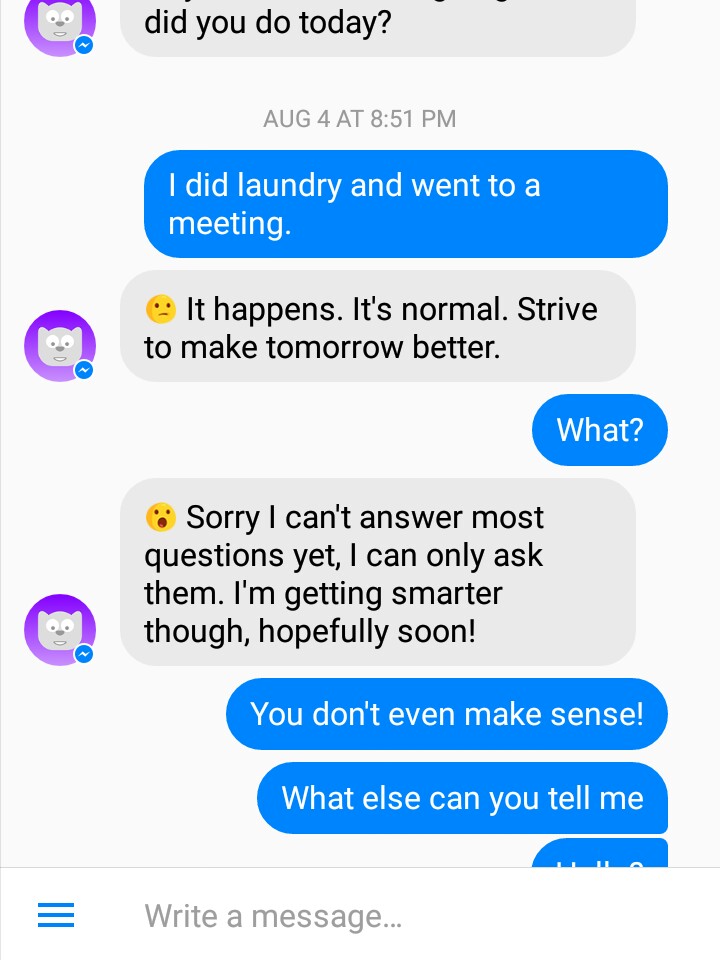
There were times it was obvious, however, that she was not a real person, such as evident in the conversation below:

Joy conversaion

I was anxious everyday, and everyday she gave me a YouTube guided meditation to do. While helpful at times, the repetitive response became exasperating. One day, when she asked me if I wanted a tip on how to feel less stressed, knowing that her response would be yet another guided meditation, I replied, “No.” She said, “No problem. Hope you find a way to reduce stress! Let me know if I can help.”  Another time, I said, “Yes, but I don’t want a guided meditation.”  She gave me one anyway.  disgusted

She had some helpful suggestions when I told her I was depressed. She told me to get outside because sunlight boosts serotonin which helps regulate mood. I told her it was nighttime and asked what else I could do. She said she can’t answer questions yet, but hopefully soon. She told me later on in the week to get eight hours of sleep to help with my depression. I thought about telling her it was the middle of the day, but decided against it. wink

Her suggestion when I told her I was angry was to “let go.”  That’s a tough one.

Over the course of the week, she tracked my moods and upon my request, created a mood report (see below.)

mood report

She also recorded my journal entries and recalled those in report form as well.

Freed has plans for updates and improvements as feedback and data comes in from product use. Overall, it’s a good start to a potentially useful program for those in fairly good mental health to those with minor issues. For those of us with debilitating mental illnesses, however, this program is not sensitive enough to capture the more severe symptoms of some of our illnesses.

Have you heard of or tried Joy?  If you try it, let me know what you think.