Thoughts on Greenberg, a Mental Patient, a Movie

Today, I watched the movie Greenberg, which was released back in 2010, but I had never seen it until now. It is about a 40-year-old man named Roger Greenberg (played by Ben Stiller) who recently suffered a “nervous breakdown”, and takes some time away from his New York life to house-sit for his brother in L.A.
movie, Greenberg, mental patient, mental illness

My educated guess is that Greenberg is bipolar, although a brief “stay in a mental hospital” is all that is mentioned. His erratic behavior, self-obsession, hypercriticism, mania, impulsivity, and anger issues cause many problems in his relationships with others and with his own peace of mind. Sound familiar?

He hooks up with his brother’s assistant, Florence, a passive somewhat flighty 25-year-old, who offered the most memorable line in the movie for me as she was talking to her friend about Greenberg:

“You can tell that a lot of normal stuff is really hard for him.”

…like maintaining friendships, hosting a get-together, shopping, driving, and taking care of the family dog when it becomes ill, to name a few.

As big of an A-hole as this Greenberg could be, I felt bad for him because a lot of normal stuff is really hard for me, too, and I often get frustrated with myself…the same way Greenberg’s brother and friends get with him for “not trying harder” or “not being able to control his emotional outbursts” or “obsessing over things.”

Florence seems to see beyond Greenberg’s neurotic behaviors. She sees him not as the jerk he is on the outside, but as a person who is victim to a disease he can’t completely control.

It was a weird movie that left me feeling unsettled because it wasn’t one of those feel-good endings like he conquered all of his demons and was cured. He was still the same…just a bit more grounded with her in his life.

This post isn’t meant to be a movie review. It is meant to process the take away message I gathered, which is that Greenberg’s an ass because he has a mental illness and he’s lucky he found someone who understands that.

Seems rather depressing to me, but is this reality for some of us…if we are lucky?

What are your thoughts? How many rude, obnoxious, mean people do you know? Have you ever considered the fact that they may have a mental illness whose symptoms are flaring up? And that if they didn’t have a mental illness, they might be fairly tolerable and decent to people the majority of the time? Is mental illness an excuse for bad behavior or merely an explanation, or both?
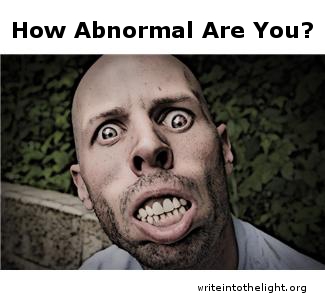
How Abnormal Are You?

abnormal mental illness

“The real hopeless victims of mental illness are to be found among those who appear to be most normal…Many of them are normal because they are so well adjusted to our mode of existence, because their human voice has been silenced so early in their lives, that they do not even struggle or suffer or develop symptoms as the neurotic does. They are normal not in what may be called the absolute sense of the word; they are normal only in relation to a profoundly abnormal society. Their perfect adjustment to that abnormal society is a measure of their mental sickness. These millions of abnormally normal people, living without fuss in a society to which, if they were fully human beings, they ought not to be adjusted.”  ~ Aldous HuxleyBrave New World Revisited

This quote kind of blows my mind. If I understand it correctly, Huxley is saying that those who are normal, or well-adjusted to life, are actually the abnormal ones, and those of us (myself included) who are “neurotic” or according the psychoanalytical theory have a:

“poor ability to adapt to one’s environment, an inability to change one’s life patterns, and the inability to develop a richer, more complex, more satisfying personality” as evident by mental illnesses such as depression, acute or chronic anxiety, obsessive–compulsive tendencies, specific phobias, such as social phobia, arachnophobia or any number of other phobias, and some personality disorders: paranoid, schizotypal, borderline, histrionic, avoidant, dependent and obsessive–compulsive

are the normal ones.

What do you think about this? Do you agree with this view of what is normal versus abnormal? Do you think that those of us with mental illness are more sensitive to the tragedies and injustices of the world? If so, why are those who aren’t as sensitive considered to be “normal” in the sense that they are mentally healthier than those of us with mental illness? Who are really the sick ones here?

Please share your thoughts in the comments below. Any type of discussion this quote may spark is appreciated.

Hopping Along – a poem

It’s Holy Week
as I reflect
on the cotton-tailed
one

who is quiet,
cautious
and reserved;

who likes to stay
in the shadows,
and frightens easily;

who burrows
under blankets
of green earth,

protected, yet
so vulnerable
while keeping close
to her family.

How To Eliminate Regret and Worry From Your Mind

20130322-225704.jpg

Soon I will be posting mental health discussion topics and questions on the Facebook page. Be sure to Like it. Thank you.

I AM Not a Mental Illness

20130321-233156.jpg

Please likeWrite into the Light on Facebook. Thank you.

You Are Not Your Mind

20130317-232046.jpg

Never Give Up

I write these for you…….and me.

cropped-img_4114

Please like Write into the Light on Facebook. Thank you.

Now On Facebook

Hey, Guys. I just set up a page for Write into the Light on Facebook. Please go there now and LIKE. Thanks so much!

xo,
WIL

Co-occurring Disorders

juggle

I found this helpful article on causes and solutions of having dual diagnoses (substance abuse AND mental illness.) I wanted to bring to you some interesting facts and highlights. To view the handout in its entirety click here to download the Hazelden Foundation’s pdf.

Factors involved in the development of psychiatric disorders:

1. Vulnerability (determined by genetics and early life experiences)
2. Stress (challenges faced in life)

Factors that can help reduce symptoms and relapses:

1. Abstaining from alcohol and drug use

“Avoiding alcohol and drug use can reduce biological vulnerability in two ways. First, because substances affect the brain, using alcohol or drugs can directly worsen those vulnerable parts of the brain associated with psychiatric disorders. Second, using substances can interfere with the corrective effects of medication on vulnerability. This means that somebody who is using alcohol or drugs will not get the full benefit of any prescribed medications for his or her disorder, leading to worse symptoms and a greater chance of relapses.”

2. Take prescription medications according to your doctor’s orders
3. Learn to use positive coping skills
4. Develop social support systems
5. Engage in meaningful activities

Which factors are you incorporating into your life to help reduce symptoms and prevent relapses? Which factors do you need to add?

The Sucky Part of Dual Diagnoses

juggle

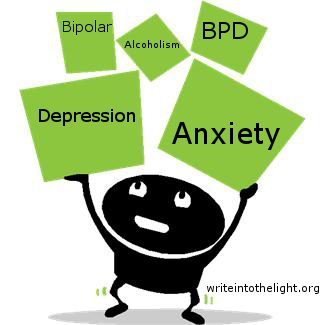
Like many of you, I have multiple mental illness diagnoses…ones in which symptoms overlap to the extent that I don’t know what I am experiencing sometimes.

Is it anxiety or hypomania? I tend to go into cleaning frenzies during both states. Is it depression or hypomania? I tend to neglect my self-care during both states? Is it bipolar or borderline personality disorder symptoms? Frequent mood swings and anger outburst appear upon exacerbations of both of these illnesses for me.

How do you distinguish between different diagnoses? Does making the distinction really matter?

For me it does…anxiety means a change in that med while mania means a change in another one. My doctor increased my antidepressant at one point in order to treat (what we thought was) my anxiety, and the change threw me into rapid cycling bipolar symptoms (a very scary place to be.)

Cycling mood swings calls for a look at my mood stabilizer OR maybe I just need to refocus my efforts on using DBT skills (Dialectical Behavioral Therapy skills are clinically effective for treating Borderline Personality Disorder.)

Depression and self-pity…is it clinical – meaning do I need a med adjustment or is it something that a few extra counseling sessions or sobriety support group meetings would alleviate?

I am grateful there are so many avenues of support and treatment for all of my disorders – counseling, support groups, skills, medications (both traditional and alternative.) However, knowing which one needs to be tweaked here and there can be quite frustrating.

Have you ever experience the frustration of having two or more diagnoses whose symptoms overlap? How do you distinguish between them or how do you cope with it? Please share. I really could use your insight.

Thanks.

hugs,
Wil