Four C’s of being a Parent with a Mental Illness

parent mental illness

I was driving my ten-year-old daughter home from her friend’s house one cool summer night. The car windows were down, and the wind whipped through our hair as the radio blasted one of her favorite songs. We sang along at the top of our lungs, laughing and screaming with delight. Just behind the excitement in her eyes I saw a touch of hesitation, a worry, and rightly so. I was manic, and while she didn’t know specifically about my bipolar disorder, on some level she recognized the signs, and it scared her…

Read the rest of my guest post today over at Dispatches From the Mad Parenthood Front.

Facebook and Its Negative Effect on Mental Health

no facebook

I gave up my personal Facebook activities last week. Note: You can still find me on Write into the Light’s Facebook Page, but, I have pushed my personal profile account to the side. Deleted the app from my phone. Haven’t checked status updates in five days which means…

I have no clue whose kid just made the honor roll, who is having a bad day at work, what everyone is having for dinner tonight, or how everyone’s nieces and nephews are doing in sports. I haven’t seen one photo-quote, inspirational or humorous. Not one recipe or emoticon from friends of friends whom I would probably not even recognize if I ran into them at the grocery store.

Top 3 Reasons to Give Up Facebook

1. The People in My House are More Important to Me than Those I Hardly Ever See

It is hard enough to filter through the minute details of my own life, let alone those of acquaintances. And that is what the majority of those on my friends list are: acquaintances. Knowing of their daily happenings makes no difference in the quality of my life. On the contrary, it wastes time and energy that would be better spent on the people with whom I actually live and on my own mental health.

2. I am a Highly Sensitive Person

Since I am a highly sensitive person who picks up on and internalizes the emotions of other people, I was finding myself being negatively effected by the sad events being shared on Facebook, from political cries to save the abused animals posts to the depressing events in people’s personal lives.

I am not saying that I don’t want to hear about the death of a dear friend’s father or the house fire of another. What I am saying is that I would rather hear about it through a phone call than on Facebook. As far as the political and social movement stuff – I don’t watch the news so as to avoid those things, so I definitely don’t want to see them in my Facebook feed.

And if you are that old friend from high school whom I haven’t seen in twenty years who has lost your job or been in an accident or gotten a divorce…I feel bad for you, but if it wasn’t for Facebook I wouldn’t even know what you look like now, let alone about the happenings in your life. No offense.

3. My Mental Health is More Important than Knowing Things About People I Haven’t Spoke to in Decades

My decision to cut Facebook out of my life came shortly after a high school classmate committed suicide, which triggered many negative emotions in me due to losing a very close friend to suicide two years ago.

After hearing about my classmate on Facebook, I grieved for a week, barely able to get out of bed some days. Grieved not really for my old classmate since I haven’t seen him in 15 years, but for my close friend all over again. It was very difficult to go through, and it could have spiraled my depression out of control.

(Thankfully, I did some mindfulness practice, talked to several people about my feelings, prayed, and wrote about it here, knowing that as long as I didn’t ignore or cover up my feelings, they would eventually pass and I’d feel better. And they did.)

However, I realized that if it wasn’t for Facebook, I never would have heard about my classmate’s suicide, and therefore, would have avoided a week of suffering because of it. No one called me, no one even directly told me about his suicide. I merely happened upon it by accident…on Facebook.

So, no more Facebook for me. How does Facebook affect your mental health? Have you ever even thought about its effects on you?

Borderline Personality Disorder and Motherhood

I bee lined down the hall into the bathroom, and shut and locked the door behind me before falling to my knees. Covering my face with my hands, I sobbed. Outside, my two and six year old girls banged on the door. “Moooommy! Moooommmyyy!” I thought, “Oh, my God! Why can’t they just leave me alone?”…

Read more of my guest post today at Healing from BPD’s website.

An Open Letter to Those Contemplating Suicide

TRIGGER WARNING: Suicide

hemingway

An open letter to those contemplating suicide:

I have been where you are, and I know how you feel. Do not shake your head, please. I really do know…the gut-wrenching emptiness, the suffocating weight, the terrifying loneliness, the absolute certainty that you will never feel any better than this moment.

I know the maddening thoughts which peck away at your mind like a vulture picking and pulling rotting meat from a carcass. I know the horrifying realization that you have no control over your feelings; that no one can know the depths of your despair and worse, that no one can save you from the black hole swallowing your mind and soul.

I know the physical aches and pains, the dead-weight of every extremity as you try to simply move from one position to another; the grayness of the world, day in and day out; the tears, the endless stream of tears; the absolute void of anything positive; the loss of all things which use to bring you peace and joy. These things I know.

I have also been where they are, and I know how they feel. Please do not doubt me. I really do know… the feel of the hard floor hitting their knees after hearing the news of your death; the anguishing pit in their stomach as bile rises in response to the action you took; the constant and nagging nightmares of what your last thoughts were before you swallowed the pills, pulled the trigger, fell from the chair, jumped, or cut through your vein.

I know their flashes of imagery at how you must have looked while you died and right after; their regrets of things said or things not said, and never having the opportunity to tell you that you don’t have to do this; that you don’t have to choose a path that will cause so much horrific pain and devastation to those you leave behind.

I know the clutching of their hearts and their screams of “No, no, no!” I know how they’ll have to live the rest of their days wishing they could see you smile one more time; give you one more hug; share one more laugh, cry, argument or anything with you. I know that they will never stop thinking of you, or truly be able to fill the spot you tore from their being.

I know depression is a disease of perception, and it wants nothing more than to kill you. It is a disease of the body, attacking mercilessly. But it is also a disease that can be treated. No matter how many times treatment has failed, if there is breath then there is still hope.

Please do not take away the ever-present possibility of help. Breathe for one more day. Tell someone you are thinking of suicide, and then breathe again for another day. Tell someone else you are thinking of suicide, and breathe yet for one more day. Keep breathing and keep telling someone how you feel.

Be honest with those who can and will help you – family, friends, and professionals. If you don’t have those options, find another professional and another until someone can help you. Call a stranger, a hotline, go to a support group and ask for help; keep reaching out to someone; keep asking for help. Find people who will care. They are out there; keep searching and don’t stop until you find them.

And most importantly, keep breathing. As long as there is breath, there is hope.

New Issue of Turtle Way – a journal for those with Mental Illness

Happy Friday, everyone! A new issue of Turtle Way was just published. Read it here, and have a beautiful weekend.

Turtle Way Logo

Mental Illness and Anonymity

mental illness anonymity

There are several reasons why I choose to maintain my anonymity on this mental illness blog.

The primary reason is to avoid hurting family members. Many of my mental illness symptoms, in particular my anxiety, are directly related to childhood events. For me to publicly identify myself while revealing facts about my upbringing would be harmful to my family members.

Even though there are benefits of adding my face and real name to the content of this blog, such as increased credibility and to support the cause for an end to the mental illness stigma, I will not do so at the expense of another’s peace of mind and privacy.

The second biggest reason I choose to maintain my anonymity is to maintain a sense of humbleness to my message. Money, power, and prestige are not my goals. Sharing what it is like to have mental illnesses and what I do to strive for healing and peace are my goals, with the hope to inspire others struggling with similar issues.

My greatest wish is that no one ever feels like they are unique. People need to know that they are not the only ones who feel the way they do, that someone else understands how they feel and has gone through what they are going through.

Another reason I choose to maintain my anonymity is because just as I would not announce at my job or highschool reunion or in a restaurant, whether it be to a large group of people or just one or two persons I didn’t know well, that I have a mental illness, why should I do so online?

I tell those whom I am close to, to those whom I trust, when the time is appropriate and when I believe it would be helpful to the situation. Anything beyond this is not necessary for me.

This is what works for me. It may be the same, or different, for you. What are your thoughts on online anonymity and mental illness?

How Abnormal Are You?

abnormal mental illness

“The real hopeless victims of mental illness are to be found among those who appear to be most normal…Many of them are normal because they are so well adjusted to our mode of existence, because their human voice has been silenced so early in their lives, that they do not even struggle or suffer or develop symptoms as the neurotic does. They are normal not in what may be called the absolute sense of the word; they are normal only in relation to a profoundly abnormal society. Their perfect adjustment to that abnormal society is a measure of their mental sickness. These millions of abnormally normal people, living without fuss in a society to which, if they were fully human beings, they ought not to be adjusted.”  ~ Aldous HuxleyBrave New World Revisited

This quote kind of blows my mind. If I understand it correctly, Huxley is saying that those who are normal, or well-adjusted to life, are actually the abnormal ones, and those of us (myself included) who are “neurotic” or according the psychoanalytical theory have a:

“poor ability to adapt to one’s environment, an inability to change one’s life patterns, and the inability to develop a richer, more complex, more satisfying personality” as evident by mental illnesses such as depression, acute or chronic anxiety, obsessive–compulsive tendencies, specific phobias, such as social phobia, arachnophobia or any number of other phobias, and some personality disorders: paranoid, schizotypal, borderline, histrionic, avoidant, dependent and obsessive–compulsive

are the normal ones.

What do you think about this? Do you agree with this view of what is normal versus abnormal? Do you think that those of us with mental illness are more sensitive to the tragedies and injustices of the world? If so, why are those who aren’t as sensitive considered to be “normal” in the sense that they are mentally healthier than those of us with mental illness? Who are really the sick ones here?

Please share your thoughts in the comments below. Any type of discussion this quote may spark is appreciated.

The Sucky Part of Dual Diagnoses

juggle

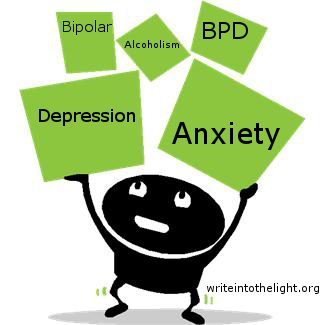
Like many of you, I have multiple mental illness diagnoses…ones in which symptoms overlap to the extent that I don’t know what I am experiencing sometimes.

Is it anxiety or hypomania? I tend to go into cleaning frenzies during both states. Is it depression or hypomania? I tend to neglect my self-care during both states? Is it bipolar or borderline personality disorder symptoms? Frequent mood swings and anger outburst appear upon exacerbations of both of these illnesses for me.

How do you distinguish between different diagnoses? Does making the distinction really matter?

For me it does…anxiety means a change in that med while mania means a change in another one. My doctor increased my antidepressant at one point in order to treat (what we thought was) my anxiety, and the change threw me into rapid cycling bipolar symptoms (a very scary place to be.)

Cycling mood swings calls for a look at my mood stabilizer OR maybe I just need to refocus my efforts on using DBT skills (Dialectical Behavioral Therapy skills are clinically effective for treating Borderline Personality Disorder.)

Depression and self-pity…is it clinical – meaning do I need a med adjustment or is it something that a few extra counseling sessions or sobriety support group meetings would alleviate?

I am grateful there are so many avenues of support and treatment for all of my disorders – counseling, support groups, skills, medications (both traditional and alternative.) However, knowing which one needs to be tweaked here and there can be quite frustrating.

Have you ever experience the frustration of having two or more diagnoses whose symptoms overlap? How do you distinguish between them or how do you cope with it? Please share. I really could use your insight.

Thanks.

hugs,
Wil

The Princess, the Pea and the Holidays

Rockefeller Center Christmas tree

Rockefeller Center Christmas tree

The holidays bring with them extra family, travel, food (usually the not-so-healthy kind), money-spending, crowds, and stress. I don’t know about you, but I have a hard enough time managing my stress on a “normal” day.

I require a low stimulating, non-demanding environment in order to remain relatively sane. I call it the “Princess and the Pea syndrome.” If you recall the children’s story written by Hans Christian Andersen, there was a princess sleeping on a dozen or so soft mattresses, and the only way to know if she was a true princess was to test her physical sensitivity by placing a pea under the bottom mattress to see if she felt it while trying to sleep.

If you are like me and the princess, then keep reading as I share the ways in which I limit stimuli to my hypersensitive system, thereby managing my holiday stress:

Family Events:

Show up late. Leave early. Tell them you have diarrhea. Who’s going to try guilting you into staying if you say you have diarrhea? Ha ha! Just kidding – don’t lie.

What I say is that I am not feeling well, which is true if my body and mind have reached their limits. Fatigue, tension in my neck and shoulders, headaches, and chills or sweating are all signs that I am beginning to experience anxiety and it is time for me to scadaddle.

Travel:

If in the car or airport for any length of time, make sure you have ways to block out extraneous sensory input, which to me is anything beyond someone honking their horn at you for weaving into their lane, or at the airport, the attendant calling for finally boarding on your flight.

Some ways I block out extra stimuli when traveling include listening to relaxing music through earphones. Sometimes I leave the ear buds in even when there is no music playing because strangers or even my kids are less likely to make small talk or bother me if they think I am listening to something.

Bring sunglasses! I don’t have a problem just shutting my eyes no matter where I am – in the airport, a restaurant, or on someone’s couch. Closing my eyes, even if just for a minute or two, really keeps me from becoming visually overstimulated.

Food:

Eat a carrot for every cookie you inhale. Do I do this? No. But it’s a good idea, right?

Shopping crowds:

Online, baby! Unless your lap is overpopulated.

I hope some of these suggestions help you manage your holiday stress this week. What do you do to decrease stress during the holidays?  Please share in the comment section below.

Thanks,
Wil

P.S. December 31, 2012 is the deadline for submissions to Turtle Way‘s next issue. Turtle Way is Write into the Light’s online mental health journal. See submission guidelines here.

How Positive Thinking Can Be a Crock

On a path to clearer views, I find myself looking up and realizing that life is nothing more than an illusion of what my mind (ego) tells me it is.

I am baffled by people who are always up-beat and positive; who love life even when things are tough; who see the good in even the most painful events.

I am writing this post and my husband, who is in the other room, just started taping up some boxes he needs to mail. Now, all I can pay attention to is the god-awful screeching sound of the tape being pulled from the tape-gun as he wraps it around the damn boxes! Like nails on a chalk board, I tell ya!

ok, I think he is finished. Like I was saying, my reality is nothing more than what my mind tells me it is. Let’s look at my outburst about the tape-gun just seconds ago. My thoughts went something like this: “Well, that made you lose your concentration which is extremely annoying! When is he going to stop doing that? I want to write and cannot with all of that racket going on!”

*uck – he’s at it again. I’ll be back…

ok, now I know he is finished because this time when the silence returned, instead of continuing to write this post I asked him nicely if he was done using the tape-gun and he said, yes. Now, I don’t have to worry about being interrupted and startled by that horribly loud sound.

One of the disadvantages of being a highly sensitive person is that what may be an average stimulus to most people is an overpowering stimulus to me. I am particular sensitive to noises. My sensory system gets overloaded if I am around too many people for too long, if the TV is too loud, if the kids have friends over playing, when car commercials come on the radio (I have to keep from going ballistic until I can turn it off), when people come in and out of the house repeatedly, when kids are outside playing loudly or a dog continuously barks… I just can’t seem to filter these things into the periphery of my awareness. Instead they dance obnoxiously in front of my face until I feel like I am going mad. Can anyone relate to that?

I am also extremely sensitive to temperature changes, bright lights, and odd smells, like when the dog needs a bath or the hamster cage needs to be cleaned. Maybe the smells are just a mom-thing, but while these noises, tactile sensations, sights, and smells are noxious to me, no one else seems to even notice them. And by noxious I mean that I get highly agitated and sometimes feel physically ill because of them.

Well, this post turned from how my mind decides what my reality is to how my sensory system is highly sensitive.

There is a fine line between what we can and cannot control. In my experience, mental illness is a biochemical phenomenon that cannot be entirely relieved by positive thinking because a large part of the illness involves the inability to control my thoughts.

Thus, “thinking positive,” “being grateful,” “pulling myself up by my bootstraps,” “getting over myself,” and other such platitudes are often ineffective. For me, until medication rearranges my brain chemicals, cognitive behavior techniques are useless. Honestly, for me, they don’t even work that well when I am properly medicated.

What works for me is getting out of my head completely. Excessive thinking is like poison for me which is why I have cut way back on my blog posts. I love reading other people’s writings, listening to positive speakers share their experiences, and creating fine art because the voices in my own head go away during these times – times in which I am completely in the present moment, not thinking about the past or wondering about the future, but experiencing exactly what is going on in the moment – as it is with no judgment of it being “good” or “bad” or otherwise, but just noticing and experiencing.

I did this with the tape-gun incident the second time around. I stopped writing, closed my eyes, stopped thinking and just listened to the sound. To my surprise, my agitation subsided.

Acceptance is the key to relieving most, if not all, of my suffering. Acceptance is the key that unlocks the door to inner peace within me no matter what is going on around me.

Now, if the TV was on, the kids were fighting, and the dirty dog was lying at my feet at the same time my husband started taping up those boxes, I am sure I would not have been able to do this. But, I believe with practice, someday I will be capable of it.

How’s that for positive thinking? 😉