Bipolar Triggers

There are external stimuli that trigger my bipolar symptoms. Strict schedules, time constraints, too much time out of the house, and extended family gatherings all wreak havoc on my mood stability. My anxiety sky rockets and, if left too high for too long, it triggers a major depressive episode.

Seasonal changes affect my moods as well. Each spring, without fail, as the grass turns green and tree buds bloom, so does my hypomania.  It lasts for about four to six weeks, fading out as the end of the school year approaches, which brings me to another trigger: change.

Each summer when my young children start summer break and each fall when they return to school, a mood shift occurs. Summer is unpredictable. It could be a return to stable from the hypomania of spring.  It could be a dip into depression.  In the fall, it is always a fall into depression. 

I’ve learned to manage my triggers by avoiding them whenever possible or at least by limiting them when appropriate. I say no to, not all but, most volunteer work. I limit my social commitments.  I get extra rest when pushed beyond what is comfortable for me.

I have to protect my mood at all costs. Does it always work?  No. Some things in life are just unavoidable. I have to cook and clean and run my kids places and show up for some commitments.  Sometimes these things all fall on the same week or day, and that’s when things get scary. That’s when I close my eyes and hope for the best while using the skills I learned in DBT (Dialectic Behavioral Therapy) as best I can. 

If my mood doesn’t bounce back after my external world settles down, that’s when I talk to my doctor about a medication change.  It happens a lot, and that’s Ok.  I have to stay on top of this bipolar thing. It’s a matter of life and death.

What are your triggers?  How do you deal with them?

A Review of “Joy,” the Chatbot Mental Health Tracker

joy

Joy is a chatbot created by product designer and front end developer, Danny Freed, using artificial intelligence. It made its debut on Facebook Messenger three weeks ago. Freed was inspired to create Joy after his friend died by suicide, in hopes that it will encourage people to open up about their mental health.

Joy initiates daily contact with the user, asking how he is feeling or how his day was. Joy attempts to detect a user’s mood and keeps a record of what it finds so the user can track his emotional state over time. Joy also gives the user suggestions on how to cope with the symptoms he may be experiencing.

I have been using Joy for nine days now. When I installed Joy in Facebook Messenger, which is the only way to use Joy thus far, it started off by asking me how I felt over the last thirty days. Then it asked me to write my first journal entry. It was a pleasant start to my relationship with Joy.

The very next evening, I received a notification from Messenger indicating a message sent from Joy. She said, “Happy Monday. How’s it going? Did anything unexpected happen today?” I told her about my day, and she accurately assessed that I was “stressed out,” and asked me if I wanted a tip for how to feel less stressed. I said, “Yes!”  She proceeded to give me a link to a guided meditation on YouTube she said would help, and it did!

(You’ll notice that I am now referring to Joy as a “she.” The natural language of Joy’s programming makes it feel like you are talking to a real person at times; it is easy to personify “her.”)

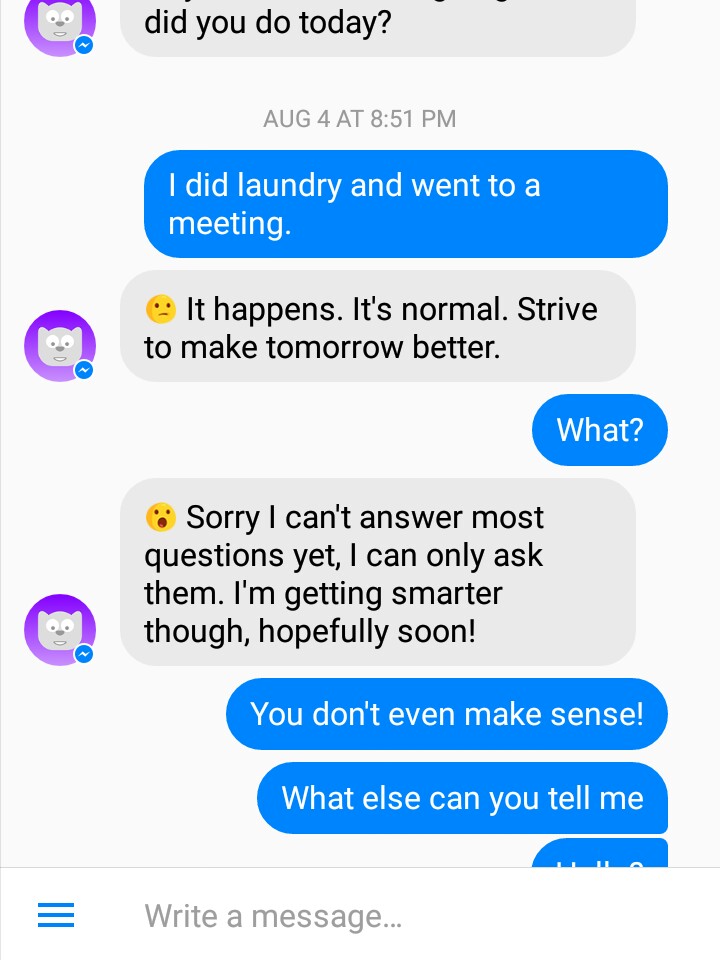
There were times it was obvious, however, that she was not a real person, such as evident in the conversation below:

Joy conversaion

I was anxious everyday, and everyday she gave me a YouTube guided meditation to do. While helpful at times, the repetitive response became exasperating. One day, when she asked me if I wanted a tip on how to feel less stressed, knowing that her response would be yet another guided meditation, I replied, “No.” She said, “No problem. Hope you find a way to reduce stress! Let me know if I can help.”  Another time, I said, “Yes, but I don’t want a guided meditation.”  She gave me one anyway.  disgusted

She had some helpful suggestions when I told her I was depressed. She told me to get outside because sunlight boosts serotonin which helps regulate mood. I told her it was nighttime and asked what else I could do. She said she can’t answer questions yet, but hopefully soon. She told me later on in the week to get eight hours of sleep to help with my depression. I thought about telling her it was the middle of the day, but decided against it. wink

Her suggestion when I told her I was angry was to “let go.”  That’s a tough one.

Over the course of the week, she tracked my moods and upon my request, created a mood report (see below.)

mood report

She also recorded my journal entries and recalled those in report form as well.

Freed has plans for updates and improvements as feedback and data comes in from product use. Overall, it’s a good start to a potentially useful program for those in fairly good mental health to those with minor issues. For those of us with debilitating mental illnesses, however, this program is not sensitive enough to capture the more severe symptoms of some of our illnesses.

Have you heard of or tried Joy?  If you try it, let me know what you think.